
What Does Skin Cancer Look Like? Pictures, Signs & When to Get Checked
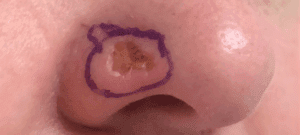
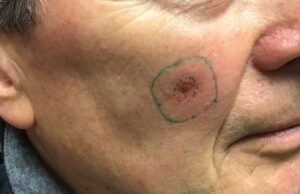
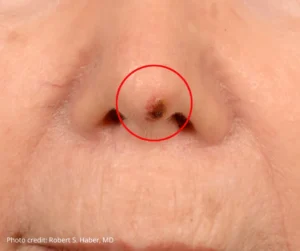
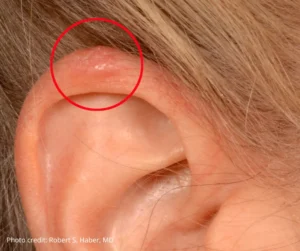
What Does Skin Cancer Look Like?
Found a spot you’re not sure about? You’re in the right place. Most skin cancers are found by people who simply noticed something new or changing on their skin. Below, you’ll see what common skin cancers can look like, where they tend to appear, and how to know when it’s time to have a spot checked.
When found early, basal cell and squamous cell skin cancers (the two most common types) are highly treatable.
Common Skin Cancers Often Look Like This:
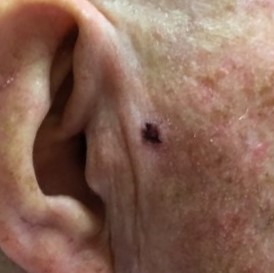
Basal cell skin cancer (the most common type) may look like:
- A shiny, skin-colored or pearly bump that may bleed or scab over
- A flat, scaly patch with a raised edge that grows slowly
- A white, waxy, scar-like area without a clear border
- A brown, black, or blue lesion with a slightly raised, translucent border
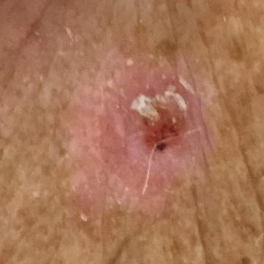
Squamous cell skin cancer may look like:
- A firm, red nodule
- A flat sore with a scaly crust
- A rough, scaly patch that persists or worsens
- A raised area on an old scar or ulcer
The pattern that matters most: a spot that doesn’t heal, keeps coming back, or keeps changing. Pimples, bug bites, and scrapes go away. Skin cancer doesn’t.
Not sure if it’s a pimple, freckle, or something more?
Have Questions About a Spot — or a Diagnosis?
You don’t have to figure this out alone. Skin Cancer Information Specialists are available to answer your questions about warning signs, screening, or local treatment options at no cost and no obligation.
Where Skin Cancer Shows Up and What It Looks Like
Skin cancer most often develops where skin gets the most sun. If you’re worried about a specific spot, start with its location:
| Location | What to look for | Additional info |
|---|---|---|
| Nose | Red spot that won’t go away, shiny bump, scab that keeps returning | Skin cancer on the nose |
| Face | Scaly patches, color changes, new or changing spots | Early signs on the face |
| Forehead | Rough patch, pink spot, sore or scab that doesn’t heal | Skin cancer on the forehead |
| Ears | Scaly patch, shiny bump, sore near or behind the ear | Skin cancer on ears |
The ABCDEs: A Simple Way to Check a Spot
Use this five-letter check on any new or changing mole or blemish:
- A — Asymmetry: Does one half look different from the other?
- B — Border: Are the edges uneven, blurred, or notched?
- C — Color: Is the color uneven, or are there darker areas within it?
- D — Diameter: Is it larger than a pencil eraser (about 6 mm)?
- E — Evolving: Has its size, shape, color, or texture changed?
If you answered “yes” to even one of these, have a dermatologist take a look. Some harmless spots look concerning, and some concerning spots look minor. A trained eye (and if needed, a simple biopsy) is the only way to know.
When Should You See a Doctor?
Make an appointment promptly if you notice:
- A sore that never fully heals, or a scab that keeps coming back in the same place
- A spot that itches, is tender, or bleeds
- A mole or blemish that has changed in size, shape, color, or texture
- Redness or darker pigment spreading beyond a spot’s border
What happens next is simpler than most people expect. A dermatologist will examine the spot, and if anything looks unusual, they may take a small sample (a biopsy) to check it. Many biopsies remove the entire area of concern in one visit. Getting checked early is the single best thing you can do. The earlier a skin cancer is found, the more treatment choices you have.
If It Is Skin Cancer, You Have Options
Most people are surprised to learn surgery isn’t the only path. Common treatments for basal cell and squamous cell skin cancers include Mohs surgery and a surgery-free alternative:
GentleCure® is the surgery-free way to treat common skin cancers. Treatment with Image-Guided SRT (IGSRT) uses advanced imaging to precisely target the cancer with low-energy X-rays and lets you and your care team see the cancer shrinking over the course of treatment.
- No cutting. No stitches. No reconstructive surgery.
- No limits on daily activities — sessions take about 15 minutes
- 99%+ cure rate for basal and squamous cell skin cancers, see the peer-reviewed IGSRT Study.
Considering Mohs? See how IGSRT compares
Do I need a referral to get a spot checked?
Requirements vary by insurance, but many dermatologists accept self-scheduled skin checks. If a spot worries you, don’t wait.
Where does skin cancer usually appear?
Most often on sun-exposed skin: the face, nose, ears, scalp, neck, forearms, and hands. It can develop anywhere, including areas that never see the sun.
Is a scab that keeps coming back a warning sign?
It can be. Recurring scabs or sores in sun-exposed areas like the nose and forehead are common warning signs of basal or squamous cell skin cancer.
How do I tell a pimple from skin cancer?
Time. A pimple resolves in days to weeks. A spot that lasts weeks, bleeds, crusts, or returns in the same place should be checked.
Can skin cancer be flat?
Yes. Early basal cell and squamous cell skin cancers can appear as flat, red, or scaly patches that resemble dry skin or a faint scar.
Everyone Deserves a Surgery-Free Treatment Option
Participate in change. Do not let radiation oncologists limit your treatment options to protect their income. Sign a FREE petition to tell Medicare and health insurers that you expect them to CONTINUE COVERING an FDA-cleared, less invasive treatment option.