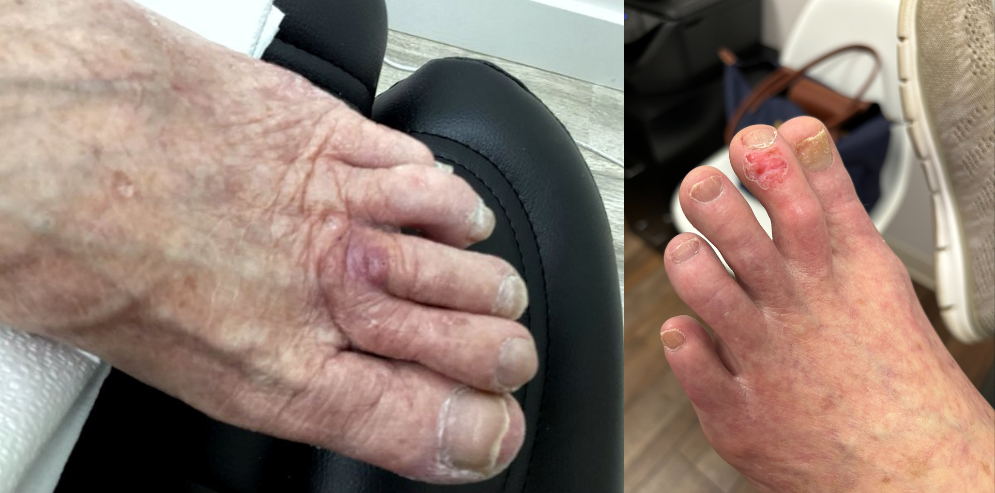
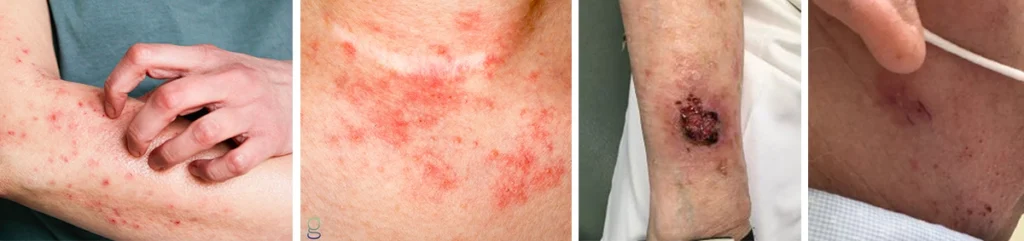
Melanoma—the most dangerous kind of skin cancer—usually looks like a mole, not a rash. However, yes, skin cancer can sometimes look like a rash, especially in its early stages. In fact, many people ask “can skin cancer look like a rash?” because it is often confused with eczema, psoriasis, or dermatitis. Although neither basal cell skin cancer nor squamous cell skin cancer will appear as a rash 100% of the time, either type of skin cancer may start out as a red, scaly patch of skin that could be mistaken with other skin conditions. Skin rash may also be a sign of other types of cancer. It’s important to learn the differences between rashes and cancer. GentleCure is here to help you compare both.
Skin Cancer vs. Rash: Know the Signs
A red, scaly patch on your skin may be a standard rash, eczema, psoriasis, or a sign of common skin cancer—but what does a skin cancer “rash” look like? The answer is that skin cancer can look like a rash, but it usually has features that make it different. Can you develop a rash from cancer? When you’re trying to decide if something is a rash or cancer, here are a few things that you’ll want to keep in mind:
- Any unusual skin changes should be discussed with your dermatologist at the earliest opportunity.
- Skin cancer is usually localized to a specific area, whereas rashes and other skin conditions can spread over a wide portion of the body.
- Certain types of skin conditions and rashes can produce flakes or shedding of skin, whereas skin cancers are usually more firm.
- Basal cell skin cancer may start as a patch of skin that looks like a rash. Over time, it may expand, forming an indentation at the center which might begin to ooze or bleed.
- Skin cancer will usually, though not always, appear on the parts of the body that receive the most sun exposure. Skin rashes can appear on the face, but many others will appear on the arms, legs, or torso. Psoriasis commonly appears on the “folds” of the body, like the elbows and knees. Eczema can appear on the hands, neck, elbows, and feet, or around the eyes.
- Most rashes will go away on their own, or with the help of over-the-counter medications like hydrocortisone. Skin cancer rashes do not heal with creams or lotions, and that means duration is one of the most important differences to note when comparing skin cancer vs. rashes.
Early detection is an important determiner of outcomes wherever cancer is concerned, and it’s always better to err on the side of caution. Keep a close eye on changes to your skin, and know when to schedule a professional screening.
Rash from Cancer: Is Rash a Sign of Cancer?
Can cancer cause skin rashes? Yes, in some cases—but it’s important to understand the difference between a skin rash caused by skin cancer and a rash caused by another form of cancer.Skin cancers and skin rashes are separate phenomena that may resemble one another, but a skin rash can be caused by cancer that’s hidden from your view. This is why people often ask “does skin cancer cause rashes?”—the answer depends on the type of cancer. Where other types of cancer are considered, skin rashes can be a clear—and directly connected—symptom. Below, you’ll find some of the less common versions of cancer that can cause skin rashes, or rash-like symptoms:
- Leukemia: The loss of platelets in the body by this blood cancer can lead to broken blood vessels under the skin that resemble a rash.
- Mycosis fungoides: One of the earliest signs of mycosis fungoides is the skin will develop rash-like patches that eventually become sores and tumors as the white blood cells attack the skin.
- Sézary syndrome: Classified as a leukemia version of mycosis fungoides, this type of cancer can cause an itchy, red rash to develop over the majority of the body — up to 80%.
- Kaposi sarcoma: A type of cancer that develops in the lining of blood vessels and the lympthatic system, it can cause lesions on the skin’s surface that are deep red, purple, or brown.
If you’re worried about a rash that doesn’t go away, or you’re unsure whether it’s related to skin cancer or another condition, schedule an evaluation. Only a medical professional can confirm whether it’s a harmless rash, skin cancer, or a rash caused by another type of cancer.
Rash vs. Skin Cancer: Key Differences
| Feature | Typical Rash (Eczema, Psoriasis, Dermatitis) | Skin Cancer Rash (Basal, Squamous, Melanoma) |
| Cause | Inflammation, allergies, immune response | Abnormal growth of skin cells (cancerous) |
| Appearance | Red, itchy, scaly patches; may spread widely | Localized red or scaly patch, firm or raised, may ooze or bleed |
| Spread | Often appears on multiple areas (arms, legs, torso, folds of skin) | Usually stays in one spot but grows slowly over time |
| Duration | Improves with creams, medications, or disappears naturally | Persists, worsens, and does not heal with creams or ointments |
| Texture | Flaky, itchy, soft patches | Firm, raised, may feel rough or develop a sore |
| Response to Treatment | Responds to OTC creams (hydrocortisone, moisturizers) | No improvement with creams; requires medical treatment |
| Warning Signs | Discomfort but usually manageable | Persistent, evolving, or bleeding patch; mole-like changes |
| When to See a Doctor | If rash is severe or recurrent | If a “rash” does not heal after a few weeks, changes in appearance, or bleeds |
FAQ
Yes. Skin cancer, especially basal cell or squamous cell skin cancer, can sometimes appear as a red, scaly patch that looks like a rash. These rashes do not go away with creams or medications, which helps distinguish them from eczema or dermatitis.
A cancer rash may look like a red or pink patch, scaly skin, a sore that won’t heal, or a spot that becomes raised and firm. Unlike typical rashes, it usually stays in one area, gets worse over time, and may bleed or crust.
Melanoma usually looks like a mole, but in some cases it can appear as a reddish or inflamed patch of skin. These patches often change in color, shape, or size, which is why they should be examined by a dermatologist.
Skin cancer itself may cause rash-like patches, but persistent rashes are more often a symptom of other conditions. However, some cancers—like leukemia, mycosis fungoides, or Kaposi sarcoma—can cause widespread rash-like symptoms on the skin.
Most rashes spread, itch, and go away with treatment. Skin cancer rashes tend to stay in one place, feel firmer, and do not heal with over-the-counter creams. If a rash lingers for weeks or changes in appearance, it should be checked by a dermatologist.
See a doctor if a rash doesn’t improve with treatment, lasts more than a few weeks, or appears alongside other changes like bleeding, crusting, or a growing spot. Early evaluation is key to ruling out skin cancer or detecting it at an early stage.
For Common Skin Cancer, Consider GentleCure®
Many types of common skin cancer can be treated with Image-Guided Superficial Radiotherapy (Image-Guided SRT), which carries no risk of surgical scarring. If your apparent rash turns out to be basal cell skin cancer or squamous cell skin cancer, talk to your doctor to find out if GentleCure® is right for you. For a more informed conversation, contact us online to speak with our skin cancer information specialists.