Can skin cancer be treated without surgery? Yes. Certain basal cell and squamous cell skin cancers may be treated with surgery-free approaches, including Image-Guided Superficial Radiation Therapy (IGSRT), also known as Image-Guided SRT. This treatment uses ultrasound imaging and targeted radiation to treat eligible skin cancers without cutting or stitches.
Surgery remains an important and effective treatment for skin cancer, but it is not the only option for every patient. Depending on the diagnosis, cancer type, size, depth, location, medical history, and other factors, a dermatologist may recommend Mohs surgery, surgical excision, IGSRT, or another treatment approach.
Understanding the available options can help you make an informed decision with your dermatologist.
What Common Skin Cancers Can Be Treated Without Surgery?
Certain nonmelanoma skin cancers may be treated without surgery, depending on their characteristics and the patient’s medical circumstances.
The two main types of nonmelanoma skin cancer are basal cell skin cancer and squamous cell skin cancer.
Basal Cell Skin Cancer
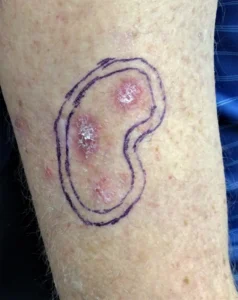
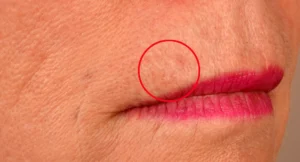
Basal cell skin cancer is one of the most common forms of skin cancer. It often appears on areas frequently exposed to sunlight, such as the face, ears, neck, scalp, and arms.
Basal cell skin cancer may look like:
- A shiny or pearly bump
- A pink or flesh-colored growth
- A sore that does not heal
- A scab that keeps returning
- A flat or slightly raised patch
- A spot with small, visible blood vessels
Mohs surgery and surgical excision are common treatment approaches. However, radiation therapy, including IGSRT, may be an option for certain eligible patients.
Squamous Cell Skin Cancer
Squamous cell skin cancer can appear as a rough, scaly, crusted, or thickened area of skin. It may also look like a firm bump, wart-like growth, or sore that does not heal.
Common signs include:
- A rough or scaly patch
- A firm red or pink bump
- A crusted sore
- A wart-like growth
- A thickened area of skin
- A spot that bleeds or becomes tender
Treatment depends on whether the cancer is considered low-risk or high-risk, along with its size, depth, location, and other clinical characteristics.
Surgery is frequently recommended, particularly for higher-risk cases. However, radiation therapy may be appropriate for selected patients.
Can Melanoma Be Treated With IGSRT?
IGSRT is not a treatment for melanoma.
Melanoma is a different type of skin cancer that can be more aggressive and requires its own diagnosis and treatment approach. If melanoma is suspected, a dermatologist should evaluate the area promptly.
How Does Image-Guided SRT Work?
Image-Guided SRT, also known as IGSRT, is a surgery-free treatment option for certain basal cell and squamous cell skin cancers.
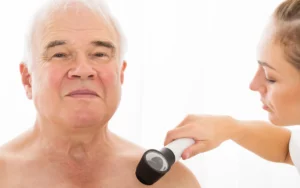
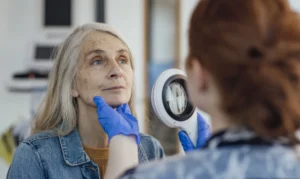
The treatment combines superficial radiation therapy with high-resolution ultrasound imaging to help providers visualize and monitor the treatment area.
During treatment:
- Ultrasound imaging: Helps the provider assess the skin cancer’s location and depth and monitor the treatment area.
- Targeted radiation: Low-energy X-rays are directed toward the affected area according to an individualized treatment plan.
- Outpatient sessions: Treatment is typically delivered during a series of appointments at a participating dermatology practice.
- No surgical incision: IGSRT does not involve cutting or stitches.
Unlike surgery, IGSRT does not require removing the skin cancer through a surgical incision. Instead, radiation is used to treat the affected tissue over a planned series of sessions.
The exact number of sessions and treatment schedule depend on the diagnosis and provider recommendation.
Why Consider Surgery-Free Treatment for Skin Cancer?
Surgery-free skin cancer treatment may offer benefits for eligible patients, particularly those who want to understand the available alternatives to surgical procedures.
However, every treatment approach has advantages, limitations, and possible side effects. The appropriate choice depends on the individual diagnosis.
No Cutting or Stitches
IGSRT does not involve surgically removing the affected tissue. This means patients do not require a surgical incision or stitches as part of their IGSRT treatment.
However, radiation treatment may cause temporary or longer-lasting skin changes, including redness, irritation, tenderness, or changes in skin appearance. Your provider can explain what to expect.
Minimal Downtime
Because IGSRT does not create a surgical wound, patients can generally continue normal daily activities during treatment.
Individual experiences may vary, and your treatment team may recommend specific skin care instructions or activity adjustments based on how the treated area responds.
Ultrasound Imaging During Treatment
Image-Guided SRT uses ultrasound imaging to help visualize and monitor the treatment area.
This imaging component distinguishes IGSRT from superficial radiation therapy performed without image guidance.
Treatment Without Surgical Removal
For certain eligible patients, IGSRT provides an option that does not require cutting out the skin cancer.
This may be an important consideration when discussing treatment choices with a dermatologist, particularly when a lesion is located in a visible or sensitive area.
Outpatient Treatment Sessions
IGSRT is typically delivered in a dermatology practice through a planned series of appointments.
Although individual appointments may be relatively short, the treatment course involves multiple visits. Patients should discuss the treatment schedule and follow-up requirements with their provider.
How Does Surgery-Free Skin Cancer Treatment Compare With Mohs Surgery?
Mohs surgery and IGSRT are different treatment approaches that may be considered for certain basal cell and squamous cell skin cancers.
Mohs surgery is a surgical procedure that removes layers of cancerous tissue and examines them under a microscope until no cancer cells are detected at the examined margins.
IGSRT uses ultrasound imaging and targeted radiation to treat the affected area without surgically removing the tissue.
Key Differences Between IGSRT and Mohs Surgery
| Treatment Feature | Image-Guided SRT (IGSRT) | Mohs Surgery |
|---|---|---|
| Treatment approach | Non-surgical radiation treatment | Surgical removal of cancerous tissue |
| Imaging or tissue examination | Uses ultrasound imaging to assess and monitor the treatment area | Uses microscopic examination of removed tissue |
| Cutting or stitches | Does not require cutting or stitches | Requires surgical tissue removal; stitches may be needed |
| Treatment schedule | Multiple outpatient sessions | Often completed in one surgical visit, which may take several hours |
| Recovery considerations | No surgical wound, but radiation-related skin reactions may occur | Surgical wound care and healing may be required |
| Treatment eligibility | Appropriate for selected basal cell and squamous cell skin cancers | Commonly used for certain skin cancers, particularly those with higher-risk features |
Both approaches can be effective in appropriate clinical situations. However, neither treatment is automatically the best choice for every patient.
Your dermatologist can explain which option is appropriate based on the diagnosis, tumor characteristics, medical history, and treatment goals.
Who May Be a Candidate for Surgery-Free Skin Cancer Treatment?
IGSRT may be an option for eligible patients diagnosed with certain basal cell or squamous cell skin cancers.
A dermatologist may consider several factors when determining whether surgery-free treatment is appropriate:
- Type of skin cancer
- Tumor size and depth
- Location of the affected area
- Whether the cancer is considered low-risk or high-risk
- Whether the cancer has returned after previous treatment
- Previous radiation treatment
- Overall medical history
- Individual treatment preferences
Some skin cancers require surgery or another treatment approach, particularly when they have higher-risk characteristics.
A professional evaluation is necessary to determine whether IGSRT is an appropriate option.
Are There Other Surgery-Free Treatments for Skin Cancer?
Yes. In addition to Image-Guided SRT, other surgery-free approaches may be used for certain skin cancers.
Depending on the diagnosis, these may include:
- Topical medications: Certain prescription creams may be used for selected superficial skin cancers.
- Cryotherapy: Uses extreme cold to destroy abnormal tissue in specific situations.
- Photodynamic therapy: Uses a light-sensitive medication and a special light source to treat certain abnormal or cancerous skin cells.
- Radiation therapy: Uses targeted radiation to treat skin cancer without surgical removal.
- Other medical treatments: Advanced or complex skin cancers may require systemic treatments or other approaches recommended by a specialist.
These treatments are not interchangeable. Some are appropriate only for particular cancer types, depths, or risk classifications.
The right treatment depends on a confirmed diagnosis and the recommendation of a qualified healthcare provider.
What Should You Ask Your Dermatologist About Surgery-Free Treatment?
If you have been diagnosed with basal cell or squamous cell skin cancer, discussing your options with a dermatologist can help you better understand which treatments may be appropriate.
Consider asking:
- What type of skin cancer do I have?
- Is my skin cancer considered low-risk or high-risk?
- Is surgery necessary for my diagnosis?
- Could Image-Guided SRT be an option for me?
- How does IGSRT compare with Mohs surgery for my specific case?
- How many treatment sessions would I need?
- What side effects should I expect?
- Will I need any special skin care during treatment?
- What follow-up appointments will be required?
- What happens if the skin cancer returns?
Your dermatologist can explain the potential benefits, limitations, and expected outcomes of each treatment approach.
FAQ: Surgery-Free Skin Cancer Treatment
Can skin cancer be treated without surgery?
Yes. Certain basal cell and squamous cell skin cancers may be treated without surgery. Surgery-free options can include radiation therapy, IGSRT, and other treatments depending on the diagnosis and clinical circumstances.
What is the best surgery-free treatment for skin cancer?
There is no single best non-surgical treatment for every skin cancer. The appropriate option depends on the cancer type, size, depth, location, risk classification, medical history, and provider recommendation.
Can basal cell skin cancer be treated without surgery?
Yes. Radiation therapy, including IGSRT in eligible cases, may be an option for certain basal cell skin cancers. A dermatologist can determine whether surgery or a surgery-free approach is more appropriate.
Can squamous cell skin cancer be treated without surgery?
Yes, in selected cases. Certain squamous cell skin cancers may be treated with radiation therapy.
Is Image-Guided SRT a surgery-free treatment?
Yes. Image-Guided SRT, also known as IGSRT, is a surgery-free treatment that uses ultrasound imaging and targeted radiation to treat certain basal cell and squamous cell skin cancers without cutting or stitches.
Does IGSRT require stitches?
No. IGSRT does not involve surgical tissue removal, so stitches are not required as part of the treatment.
Is surgery-free skin cancer treatment painful?
The radiation delivery itself is generally painless. However, patients may experience skin irritation, redness, tenderness, or discomfort during the course of treatment. Individual experiences may vary.
Does IGSRT require downtime?
IGSRT does not create a surgical wound, and patients can generally continue normal daily activities during treatment. However, treatment-related skin reactions may require additional care. These side effects can be cared for by your doctor.
How long does Image-Guided SRT treatment take?
IGSRT is delivered through a series of outpatient treatment sessions. The number of visits and overall treatment schedule depend on the diagnosis and individual treatment plan.
Is Image-Guided SRT as effective as Mohs surgery?
Both IGSRT and Mohs surgery can be effective for appropriately selected skin cancers. The expected effectiveness of each treatment depends on the type of skin cancer, its size, depth, location, and whether it has been treated before. Your dermatologist can evaluate these factors, explain the expected outcomes of each option, and recommend the most appropriate treatment for your diagnosis.
Can melanoma be treated with IGSRT?
No. IGSRT is not a treatment for melanoma. Melanoma requires a different evaluation and treatment approach.
How do I know whether I qualify for surgery-free skin cancer treatment?
A dermatologist can evaluate your diagnosis, cancer type, size, depth, location, medical history, and other factors to determine whether IGSRT or another surgery-free approach may be appropriate.
Ask Your Doctor if Image-Guided SRT Is Right for You
If you have been diagnosed with certain nonmelanoma skin cancers, including basal cell skin cancer or squamous cell skin cancer, you may have more than one treatment option.
GentleCure supports the use of IGSRT, also known as Image-Guided SRT, as a surgery-free treatment option for eligible patients with certain nonmelanoma skin cancers. For appropriate candidates, IGSRT may help treat skin cancer without cutting or stitches.
Treatment recommendations depend on the diagnosis, cancer type, size, depth, location, medical history, and provider recommendation.
To learn more, call 855-936-4411 to speak with a Skin Cancer Information Specialist, find a participating dermatology practice near you, or take the Am I a Candidate? quiz to explore whether IGSRT may be appropriate for your situation.