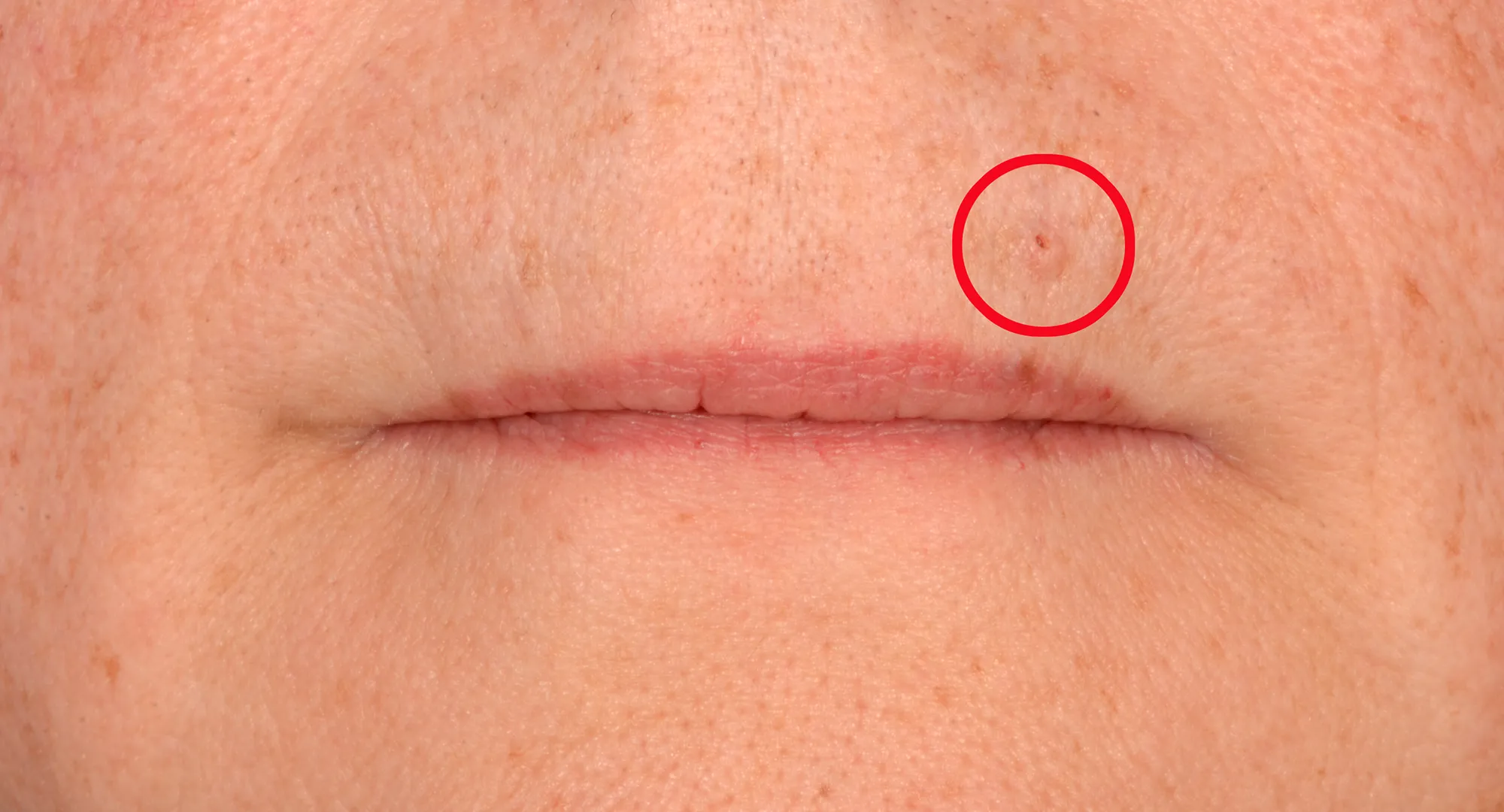
Photo Credit: Robert S. Haber, MD
What does skin cancer on the lips look like? It may appear as a sore that does not heal, a rough or scaly patch, a white or red spot, a crusted area, a lump, or a spot that bleeds, cracks, or keeps coming back. Lip changes that last should be checked by a dermatologist.
Skin cancer on the lips is often easy to mistake for chapped lips, a cold sore, irritation, a small cut, or sun damage. However, a persistent or changing spot on the lip should not be ignored, especially if it appears on the lower lip, does not heal, or keeps returning in the same place. If you are also monitoring skin cancer on the face, the same warning signs apply near the lips.
Why Skin Cancer Can Develop on the Lips
The lips are vulnerable to ultraviolet (UV) exposure because the skin is thin and often exposed during everyday activities. The lower lip is especially at risk because it typically receives more direct sunlight than the upper lip.
Skin cancer risk on the lips may be higher if you have:
- A history of sunburns
- Frequent outdoor sun exposure
- Fair or freckled skin
- A personal history of skin cancer
- A family history of skin cancer
- A weakened immune system
- A history of tanning bed use
- Tobacco use
- Long-term irritation or damage to the lips
- A rough, scaly lip condition that does not improve
Because the lips are visible and functionally important, early evaluation can help support more careful treatment planning.
What Does Skin Cancer on the Lip Look Like?
Skin cancer on the lip can look different depending on the type of skin cancer, the person’s skin tone, and how long the spot has been present.
Possible signs of skin cancer on the lip include:
- A sore that does not heal
- A scab or crust that keeps coming back
- A rough, dry, or scaly patch
- A white, red, pink, or discolored area
- A lump, bump, or thickened spot
- A spot that bleeds, cracks, or oozes
- A tender, painful, itchy, or burning area
- A flat patch that feels rough
- A persistent area of peeling or chapping in one spot
- A mole or dark spot that changes
Not every lip spot is skin cancer. Many lip changes are caused by dryness, irritation, cold sores, injury, infection, or sun exposure. The concern is when one area does not heal, keeps returning, grows, bleeds, or changes over time. Early signs of skin cancer are worth learning to recognize on the lips specifically, since they can look different from other areas of the face.
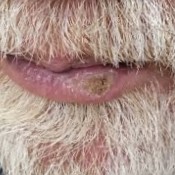
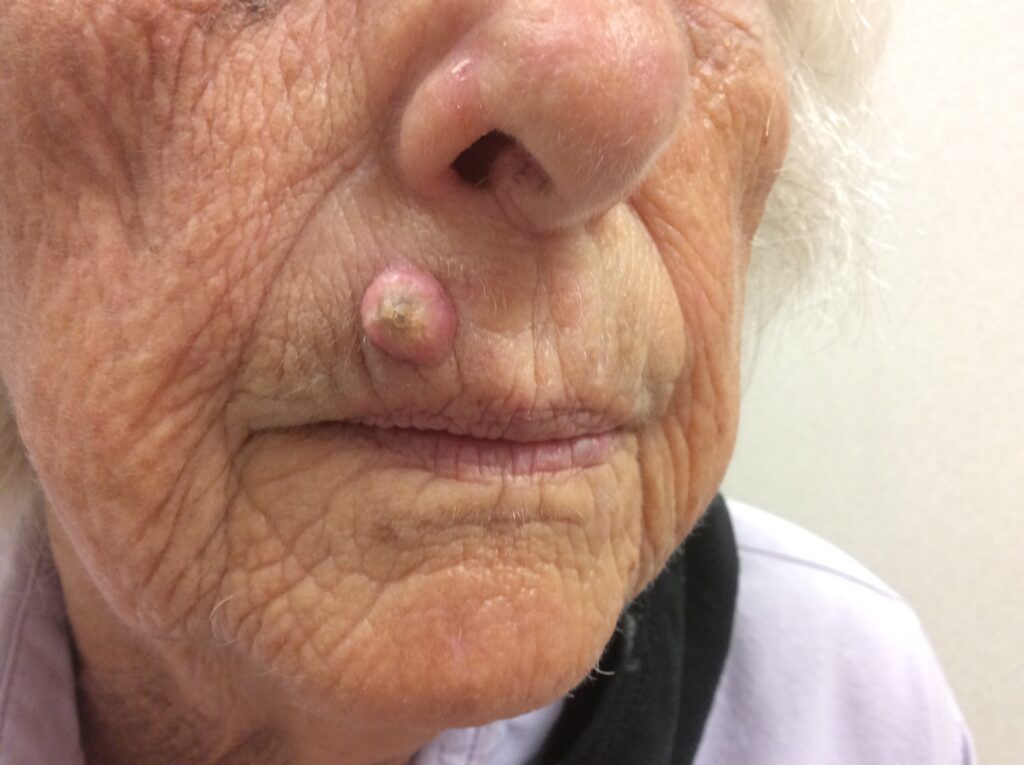
Lip Skin Cancer Pictures: What to Look For
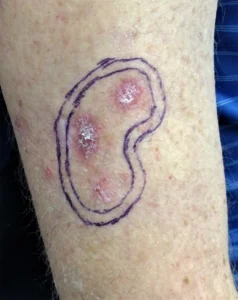
Pictures of lip skin cancer can help you understand common warning signs, but they cannot confirm whether a spot is cancerous. Skin cancer can look different from person to person, and some early spots can look mild.
When reviewing lip skin cancer pictures, look for patterns such as:
- A non-healing sore on the lower lip
- A crusted or scabbed spot that keeps returning
- A rough or scaly patch in one specific area
- A white or red patch that does not improve
- A lump or thickened area on the lip
- A bleeding or cracking spot
- A changing dark spot or mole near the lip
- A lip lesion that looks different from surrounding skin
A photo can help you recognize warning signs, but a dermatologist or healthcare provider should evaluate any persistent or changing lip spot.
Skin Cancer on the Lower Lip
The lower lip is one of the most common lip areas for sun-related damage because it often receives more UV exposure than the upper lip.
Skin cancer on the lower lip may look like:
- A rough or scaly patch
- A sore that does not heal
- A crusted area
- A white, red, or pink spot
- A persistent crack or peeling area
- A firm or thickened spot
- A spot that bleeds or becomes tender
A lower lip spot that does not improve should be checked, especially if it stays in one place or keeps coming back after appearing to heal.
Skin Cancer on the Upper Lip
Skin cancer can also appear on the upper lip, although the lower lip is often more exposed to sunlight. A spot on the upper lip may be mistaken for irritation, a shaving cut, acne, a cold sore, or dry skin.
Warning signs on the upper lip may include:
- A sore that does not heal
- A scab that keeps returning
- A rough or thickened patch
- A bump or lump near the lip border
- A red, pink, white, or discolored area
- A spot that bleeds or changes
- A lesion that looks different from other marks nearby
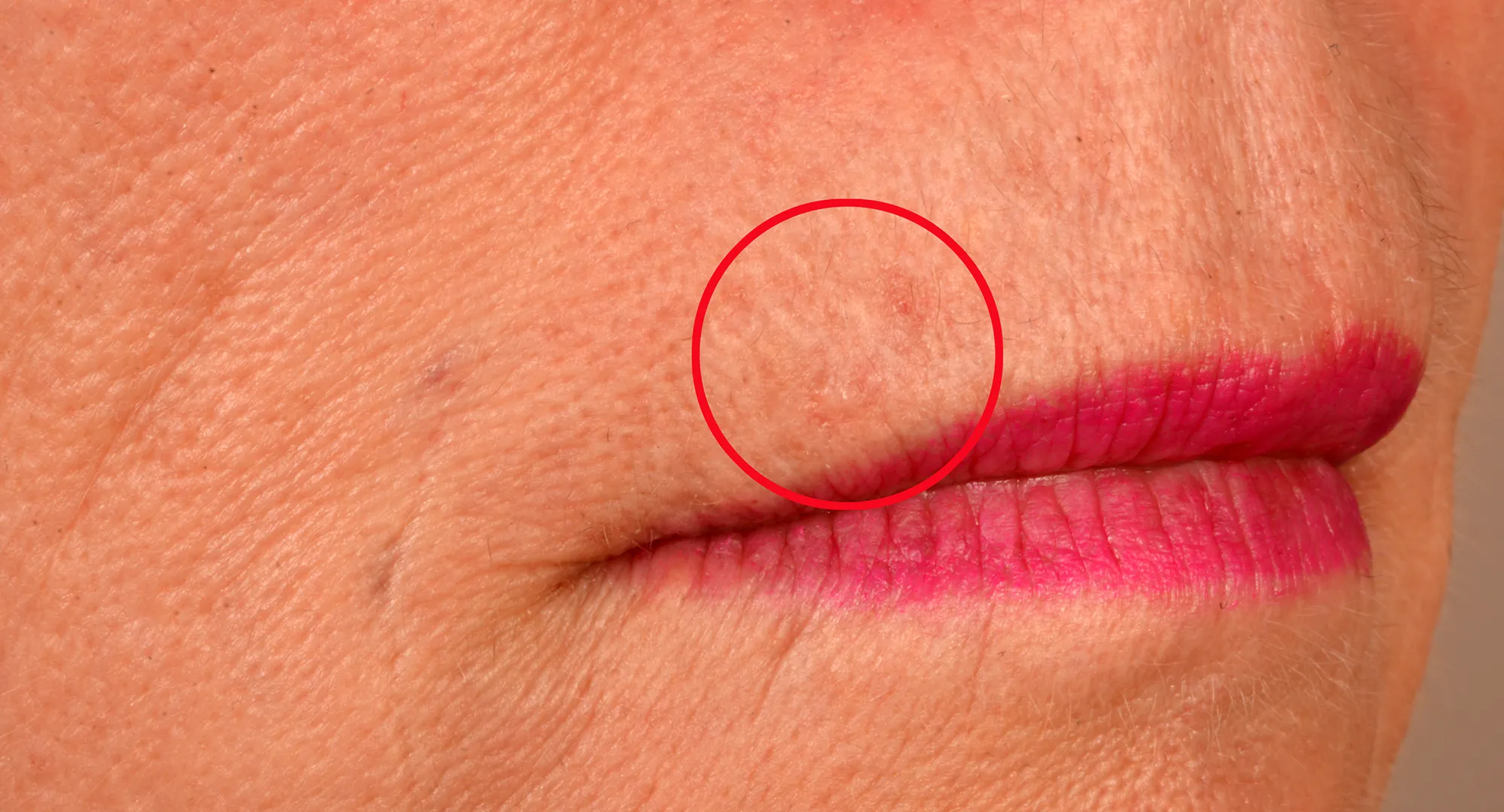
Photo Credit: Robert S. Haber, MD
Because the upper lip is close to the nose and facial skin, a dermatologist may also check nearby areas during an exam.
White, Red, or Scaly Spots on the Lip
Some lip changes appear as color or texture changes rather than obvious sores. A white, red, rough, or scaly patch may be caused by irritation, dryness, sun damage, or a precancerous change.
A condition called actinic cheilitis can affect the lips, especially the lower lip, after long-term sun exposure. It may appear as persistent dryness, scaling, cracking, discoloration, or roughness. Actinic cheilitis is considered precancerous and should be evaluated by a dermatologist or healthcare provider.
A white, red, or scaly lip spot should be checked if it:
- Does not improve
- Keeps returning
- Becomes thicker or rougher
- Bleeds or cracks
- Feels tender or painful
- Changes color, size, or texture
Can Lip Skin Cancer Look Like Chapped Lips?
Yes, lip skin cancer or precancerous lip damage can sometimes look like chapped lips. This can make it easy to dismiss early warning signs.
Chapped lips usually affect a broader area and improve with hydration, lip balm, sun protection, or changes in weather. A more concerning lip spot may stay in one specific area, keep returning, bleed, crack, crust, or become thicker over time.
You should get a persistent “chapped” area checked if it does not improve or if it appears different from the rest of your lips.
Can Lip Skin Cancer Look Like a Cold Sore?
Some lip cancers can be mistaken for a cold sore because they may appear as a sore, crusted area, or non-healing lesion. However, cold sores usually follow a more predictable pattern and often improve within a shorter period of time.
A sore on the lip should be checked if it:
- Does not heal within a few weeks
- Keeps returning in the same place
- Bleeds or crusts repeatedly
- Becomes firm, thick, or raised
- Grows or changes
- Does not behave like your usual cold sores
A dermatologist or healthcare provider can help determine whether the spot is a cold sore, irritation, precancerous change, skin cancer, or another condition.
Types of Skin Cancer That Can Appear on the Lips
Several types of skin cancer can appear on or around the lips.
Squamous cell skin cancer is an important type to watch for on the lips, especially the lower lip. It may appear as a rough patch, thickened area, crusted sore, firm bump, or sore that does not heal.
Basal cell skin cancer can also appear near the lips, especially on the surrounding facial skin. It may look like a shiny bump, pink patch, open sore, or scab that keeps returning.
Melanoma can appear on or near the lips as a new or changing dark spot, uneven patch, bleeding lesion, or spot with multiple colors. Melanoma can be more aggressive and should be evaluated promptly if suspected.
A dermatologist or healthcare provider can determine whether a lip spot is skin cancer or another condition.
How to Check Your Lips for Skin Cancer
Checking your lips regularly can help you notice changes sooner. Use good lighting and a mirror. Look at both the upper and lower lips, the lip border, the corners of the mouth, and the skin around the lips.
When checking your lips, ask:
- Is there a sore that has not healed?
- Is there a scab or crust that keeps coming back?
- Is one area persistently dry, cracked, or scaly?
- Is there a white, red, pink, or dark spot that has changed?
- Is there a lump, bump, or thickened area?
- Does the spot bleed, hurt, itch, or burn?
- Does the spot look different from the rest of the lip?
- Has the spot lasted more than a few weeks?
For moles or dark spots near the lips, use the ABCDEs:
- Asymmetry: One half of the spot does not match the other.
- Border: The edges are uneven, jagged, blurred, or poorly defined.
- Color: The spot has more than one color, such as brown, black, red, white, blue, or pink.
- Diameter: The spot is larger than a pencil eraser or continues to grow.
- Evolving: The spot changes in size, shape, color, texture, or symptoms.
The “E” for evolving is especially important. Any changing spot on or near the lips should be checked.
When Should You See a Dermatologist for a Lip Spot?
You should see a dermatologist or healthcare provider if a lip spot does not heal, keeps coming back, grows, bleeds, crusts, hurts, burns, itches, or changes in color, size, shape, or texture.
Schedule an exam if you notice:
- A sore on the lip that does not heal
- A crusted spot that keeps returning
- A rough or scaly patch in one area
- A persistent white or red patch
- A lump, bump, or thickened area
- A bleeding or cracking spot
- A changing mole or dark spot near the lip
- A lower lip spot that keeps peeling or scabbing
- A lip lesion that looks different from other marks nearby
A dermatologist may examine the area, use dermoscopy, or recommend a biopsy if the spot looks suspicious. A biopsy can confirm whether a suspicious lip spot is skin cancer or another condition. If you are due for a skin cancer screening, this is a good time to schedule one.
How Is Skin Cancer on the Lip Treated?
Treatment for skin cancer on the lip depends on the diagnosis, cancer type, size, depth, location, biopsy findings, recurrence history, medical history, and provider recommendation.
Common treatment options may include:
- Mohs surgery: A surgical technique that removes thin layers of skin and checks them for cancer cells until no cancer remains.
- Surgical removal: A procedure that removes the skin cancer along with a margin of surrounding tissue.
- Image-Guided SRT: A non-surgical treatment option for certain nonmelanoma skin cancers, including basal cell skin cancer and squamous cell skin cancer.
- Other treatments: Depending on the diagnosis, options may include topical medication, cryotherapy, photodynamic therapy, immunotherapy, radiation therapy, or another approach recommended by your provider.
The lips are sensitive and important for speaking, eating, facial expression, and appearance. Because of this, treatment planning may consider both medical effectiveness and cosmetic or functional outcome.
Is IGSRT an Option for Skin Cancer on the Lip?
IGSRT, also known as Image-Guided SRT, may be an option for eligible patients with certain nonmelanoma skin cancers, including basal cell skin cancer and squamous cell skin cancer.
For some eligible patients, IGSRT may help treat certain nonmelanoma skin cancers without cutting or stitches. It uses imaging and targeted radiation to treat the skin cancer while allowing the provider to monitor the area during treatment.
IGSRT is not appropriate for every skin cancer or every lip location. Eligibility depends on the diagnosis, cancer type, size, depth, location, medical history, and provider recommendation.
How to Help Protect Your Lips From Skin Cancer
Protecting the lips from UV exposure is an important part of skin cancer prevention. Many people remember sunscreen for the face but forget the lips.
To help protect your lips:
- Use a lip balm with sunscreen SPF 30 or higher
- Reapply lip SPF regularly when outdoors
- Reapply after eating, drinking, swimming, or sweating
- Wear a wide-brimmed hat when possible
- Avoid tanning beds, tanning booths, and sunlamps
- Do not ignore persistent dryness, cracking, or scaling in one area
- Check the lips regularly for new or changing spots
- Schedule regular skin exams if you have risk factors or a history of skin cancer
Sun protection cannot prevent every skin cancer, but it can help reduce additional UV damage and support earlier detection.
FAQ: Skin Cancer on Lips
What does skin cancer on the lip look like?
Skin cancer on the lip may look like a sore that does not heal, a scab that keeps returning, a rough or scaly patch, a white or red spot, a lump, a thickened area, or a spot that bleeds, cracks, or changes.
Can skin cancer on the lip look like chapped lips?
Yes. Skin cancer or precancerous lip damage can sometimes look like chapped lips. A dry, cracked, or scaly area that stays in one place and does not improve should be checked.
Can skin cancer on the lip look like a cold sore?
Yes, some lip skin cancers can resemble a cold sore or crusted sore. A sore that does not heal, keeps returning in the same place, bleeds, or becomes firm should be evaluated.
Is skin cancer more common on the lower lip?
Skin cancer often appears on the lower lip because it typically receives more direct sun exposure than the upper lip. Any persistent lower lip sore, scab, or rough patch should be checked.
What does squamous cell skin cancer look like on the lip?
Squamous cell skin cancer on the lip may look like a rough or scaly patch, thickened area, crusted sore, firm bump, or sore that does not heal. It may also bleed, crack, or become tender.
Can basal cell skin cancer appear on the lip?
Basal cell skin cancer can appear near the lips and surrounding facial skin. It may look like a shiny bump, pink patch, open sore, or scab that keeps returning.
Can melanoma appear on the lip?
Yes, melanoma can appear on or near the lips. It may look like a new or changing dark spot, uneven patch, bleeding lesion, or spot with multiple colors. Any changing dark spot should be checked promptly.
What is actinic cheilitis?
Actinic cheilitis is a precancerous condition of the lip caused by long-term sun exposure. It may appear as persistent dryness, scaling, cracking, discoloration, or roughness, often on the lower lip.
When should I see a dermatologist for a lip spot?
See a dermatologist or healthcare provider if a lip spot does not heal within a few weeks, keeps coming back, bleeds, crusts, grows, hurts, burns, changes color, or looks different from the rest of the lip.
How is skin cancer on the lip diagnosed?
A dermatologist or healthcare provider may examine the area and recommend a biopsy if the spot looks suspicious. A biopsy can confirm whether the lip spot is skin cancer or another condition.
How is skin cancer on the lip treated?
Treatment depends on the diagnosis, cancer type, size, depth, location, and provider recommendation. Options may include Mohs surgery, surgical removal, Image-Guided SRT, or other treatments recommended by your provider.
Is IGSRT an option for skin cancer on the lip?
IGSRT may be an option for eligible patients with certain nonmelanoma skin cancers, including basal cell skin cancer and squamous cell skin cancer. A dermatologist can determine whether IGSRT is appropriate for your diagnosis and lip location.
Learn More About Skin Cancer Treatment on the Lips With GentleCure
If you notice a lip sore, scab, rough patch, white or red spot, lump, or changing area that does not heal, schedule an exam with a dermatologist or healthcare provider. Getting the right diagnosis is the first step toward the right treatment plan.
If you have been diagnosed with certain nonmelanoma skin cancers, including basal cell skin cancer or squamous cell skin cancer, GentleCure may be an option. GentleCure uses IGSRT, also known as Image-Guided SRT, as a non-surgical treatment option for certain nonmelanoma skin cancers. For eligible patients, IGSRT may help treat basal cell skin cancer or squamous cell skin cancer without cutting or stitches.
Treatment recommendations depend on the diagnosis, cancer type, size, depth, location, medical history, and provider recommendation. To learn more, call 855-936-4411 to speak with a Skin Cancer Information Specialist, find a participating dermatology practice near you, or take the Am I a Candidate? quiz to see whether IGSRT may be right for you.