GentleCure Blog

Welcome to the GentleCure Skin Cancer Blog

Thank you for visiting our blog. If you’re looking for information on skin cancer types, skin cancer statistics, general skin cancer facts, sun safety tips, and more information you can trust, you’ve come to the right place. At GentleCure, we are on a mission to empower those with nonmelanoma skin cancer to be educated, active participants in their treatment decisions. Providing you with a breadth of knowledge about skin cancer and its treatment is just one way we can achieve that goal. Learn more below about the types of posts you can expect to find on our blog, then find out how to get in touch with us if you would like to talk with a Skin Cancer Information Specialist.

What topics are covered in our blog?

GentleCure® blog posts will cover everything from basic skin cancer facts and skin cancer statistics to more specific information regarding nonmelanoma skin cancers like basal cell skin cancer and squamous cell skin cancer. You will find answers you can trust to questions like:

  • What is nonmelanoma skin cancer?
  • What are the symptoms of basal cell skin cancer and squamous cell skin cancer?
  • What causes basal and squamous cell skin cancers?
  • Are basal and squamous cell skin cancers deadly? What are their survival rates?
  • How are basal and squamous cell skin cancers treated?

In addition to skin cancer facts and statistics, anyone considering Image-Guided Superficial Radiotherapy (IGSRT) as a surgery-free option for treating their nonmelanoma skin cancer can find helpful information about:

  • How IGSRT works
  • What to expect during treatment with IGSRT
  • How IGSRT compares to Mohs surgery
  • Much more

While past experiences with skin cancer treatment may have left you feeling in the dark and unsure of your options, GentleCure is proud to offer a refreshing approach to nonmelanoma skin cancer treatment by providing in-depth answers to all your questions.

Latest Posts

  • Two older women wearing sun hats and sunglasses smiling and laughing beside a classic car at the beach.

    7 Essential Tips to Prevent Skin Cancer on Your Face

    The face is constantly exposed to environmental elements, making it susceptible to UV damage and skin cancer. Implementing comprehensive protective measures is essential for facial skin health. Use Daily Facial Sunscreen Incorporate a broad-spectrum sunscreen with SPF 30 or higher into your daily skincare routine, applying it to all facial areas, including the forehead, cheeks,…Read More

  • Smiling older man having sunscreen applied to his face by a woman at the beach, with the ocean in the background.

    7 Proven Methods to Safeguard Your Nose from Skin Cancer

    The nose, being a prominent facial feature, is highly exposed to sunlight and vulnerable to UV damage. Implementing specific protective measures can help prevent skin cancer in this area. Apply High-SPF Sunscreen to Your Nose Use a broad-spectrum sunscreen with SPF 30 or higher on your nose, ensuring even coverage, including the bridge and nostrils….Read More

  • Three older women in sun hats and beachwear laughing and enjoying a sunny day at the beach.

    7 Effective Strategies to Prevent Skin Cancer on Your Ears

    The ears are often overlooked when it comes to sun protection, yet they are highly susceptible to UV damage due to their exposure. Implementing targeted preventive measures can significantly reduce the risk of skin cancer in this area. Prioritize Ear-Specific Sunscreen Application Apply a broad-spectrum sunscreen with at least SPF 30 directly to all parts…Read More

  • Guarding Your Skin: The Crucial Connection Between Outdoor Work and Skin Cancer

    While working outside in occupations like farming, forestry and construction has its benefits, it’s important to understand that it also increases the risk of skin cancer.  In this article, we’ll highlight that higher risk, the importance of preventing it, and the treatment options available. The Invisible Threat: UV Radiation UV (ultraviolet) radiation is the hidden…Read More

  • What is Anaplasia?

    In the simplest terms, anaplasia is used to describe a cell that has lost many of its defining characteristics or in other words has become undifferentiated. But what does that mean when it comes to cancer cells? What does it mean for anaplasia cells to be found inside a tumor? What is anaplasia? Are anaplastic…Read More

  • A doctor examining a woman's shoulder

    What’s the Difference: Metaplasia vs. Anaplasia

    Sometimes, it can be difficult to make sense of the words you’re hearing when you’re speaking to a doctor, especially when it comes to your health. How can you be expected to know the difference between specific medical terms? Terms like metaplasia vs. anaplasia often come up when speaking to a doctor about the risks…Read More

  • Close-up view of the side of a person's nose with a reddish-brown lesion surrounded by several small black marker dots, indicating the site of a skin biopsy for suspected skin cancer.

    How Does Skin Cancer Appear on the Nose?

    Can you get skin cancer on your nose? Yes, skin cancer can appear on the nose, and this is one of the most common areas for it to develop because the nose gets frequent sun exposure. It may look like a red spot, shiny bump, rough patch, sore that won’t heal, or scab that keeps…Read More

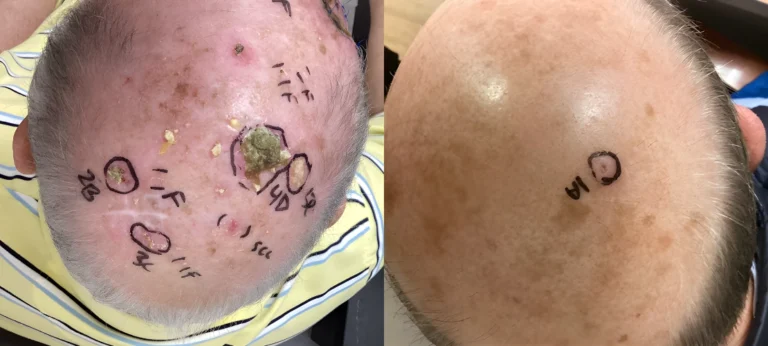
  • Skin Cancer on Forehead

    How Does Skin Cancer Appear on the Forehead?

    Can you get skin cancer on your forehead? Yes, skin cancer can appear on the forehead because this area receives frequent sun exposure. It may look like a rough patch, red spot, shiny bump, scab that keeps coming back, sore that does not heal, wart-like growth, or mole that changes over time. Because the forehead…Read More

  • Finding Support When You’re Diagnosed with Skin Cancer

    Living with a skin cancer diagnosis can be a challenging journey, not only for patients but also for their families. Finding a supportive community can make a significant difference in navigating the physical and emotional aspects of this experience. You don’t have to be alone when you’re battling against cancer. Whether you’re trying to keep…Read More

  • Elderly person with short gray hair, wearing a floral top and a watch, resting chin on hands and looking thoughtful while sitting indoors.

    What is Merkel Cell Skin Cancer?

    In 2023, singer-songwriter Jimmy Buffett passed away after a four-year-long battle with Merkel cell skin cancer. This has gotten many curious about how this type of cancer can be diagnosed and treated. When it comes to the different types of skin cancer, Merkel cell skin cancer is often cited as one of the most aggressive…Read More

  • Man and Woman using a Laptop

    Advocating for Optimal Insurance Coverage: The Change.org Petition

    More than 65,000 people facing a skin cancer challenge have made Image-Guided SRT their treatment of choice, and post-treatment satisfaction surveys show that 99.8% were both happy with their decision to treat with Image-Guided SRT and would recommend the treatment to others.Read More

  • Verrucous Skin Cancer vs. Squamous Cell Skin Cancer

    What is the difference between verrucous skin cancer and squamous cell skin cancer? Verrucous skin cancer is a rare variant of squamous cell skin cancer, one of several common forms of skin cancer. While squamous cell skin cancer can appear almost anywhere on the body, verrucous skin cancer is more localized, often appearing in specific…Read More

For more information on skin cancer treatment options, speak with a Skin Cancer Information Specialist today.