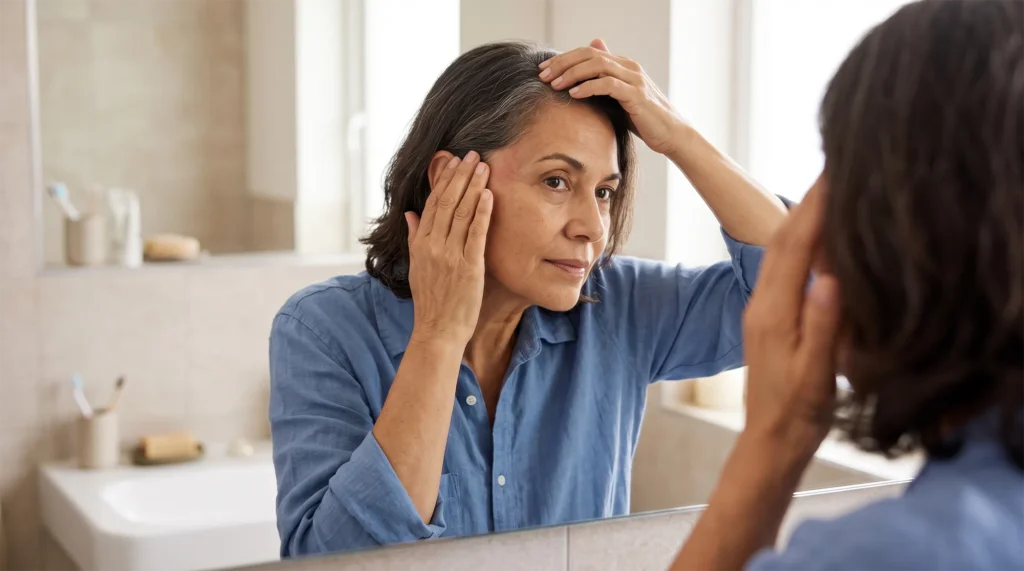
Can skin cancer appear on the hairline? Yes, skin cancer can develop along the hairline, including the forehead hairline, temples, sideburn area, part line, and skin near the ears. A scab, sore, rough patch, bump, or spot that does not heal, bleeds, grows, or changes should be checked by a dermatologist.
The hairline is easy to overlook because it sits between the face and scalp. Some people miss this area when applying sunscreen, washing their face, shaving, styling hair, or checking their skin. Hair can also hide early changes, especially near the temples, part line, or around the ears.
Not every hairline spot is skin cancer. Many spots are caused by irritation, acne, ingrown hairs, dandruff, psoriasis, eczema, hair products, shaving, hats, helmets, or minor injuries. The concern is when one spot does not heal, keeps returning, or changes over time.
Why the Hairline Is an Overlooked Area for Skin Cancer
The hairline is a transition area between the face and scalp, which can make it easy to miss during daily skin care and sun protection. People may apply sunscreen to the face but stop before reaching the hairline. Others may assume hair provides enough protection.
Skin cancer can develop along the hairline because this area may receive frequent sun exposure during everyday activities, including walking, driving, gardening, golfing, boating, exercising, or working outdoors. It is also important to understand how skin cancer on the head and scalp can appear.
The hairline may also be overlooked because:
- Hair can cover early spots
- Sunscreen may not be applied close enough to the hairline
- Hats may not fully protect the temples or sideburn area
- Hair products can irritate the skin and make spots harder to notice
- Shaving or grooming can cause scabs that hide other changes
- People may mistake a persistent spot for acne, dandruff, or irritation
- The area may not be checked during routine self-exams
Because the hairline is partly visible and partly hair-covered, it deserves its own check during skin exams.
What Does Skin Cancer on the Hairline Look Like?
Skin cancer on the hairline can look different depending on the type of skin cancer, the person’s skin tone, and where the spot appears.
Possible early signs of skin cancer on the hairline include:
- A scab that does not heal
- A sore that keeps coming back
- A rough, scaly, or crusted patch
- A shiny or pearly bump
- A firm red, pink, or flesh-colored bump
- A wart-like growth
- A spot that bleeds, crusts, or oozes
- A tender, itchy, or painful area
- A flat patch that feels rough
- A thickened or raised area
- A mole or dark spot that changes
- A spot that looks different from others nearby
A hairline spot does not have to hurt to be concerning. Many early skin cancers are painless. Persistence, bleeding, crusting, growth, or change are more important warning signs.
Scab on the Hairline That Won’t Heal
A scab on the hairline may come from scratching, shaving, dry skin, acne, an ingrown hair, dandruff, or irritation from hair products. Many minor scabs heal with time.
A hairline scab should be checked if it:
- Does not heal within a few weeks
- Keeps coming back in the same place
- Bleeds with little contact
- Crusts repeatedly
- Becomes tender, painful, or itchy
- Grows larger
- Feels firm, rough, or thick
- Appears near a changing mole or dark spot
- Looks different from other marks on your skin
A recurring scab in one specific area can be a warning sign because some skin cancers bleed, crust, or appear to heal before coming back. Learn more about bleeding or scabbing spots that may need evaluation.
Skin Cancer Near the Forehead Hairline
The forehead hairline is often exposed to sunlight, especially where hair is thin, receding, parted, or pulled back. This area can also be missed when applying sunscreen.
Skin cancer on the forehead near the hairline may look like:
- A rough patch at the edge of the hairline
- A small sore that does not heal
- A pink, red, or flesh-colored bump
- A scab that returns after washing or brushing hair
- A shiny or pearly spot
- A crusted or tender area
- A changing mole or dark spot
Because the forehead hairline is close to the face, patients may also notice changes when washing their face, applying moisturizer, shaving, or styling hair.
Skin Cancer Near the Temples and Sideburn Area
The temples and sideburn area can receive frequent sun exposure, especially when hats, sunglasses, or hairstyles leave these areas uncovered. Spots in this area may be mistaken for irritation from glasses, shaving, hair dye, or hair products.
Watch for:
- A sore near the temple that does not heal
- A rough or crusted patch near the sideburn
- A bump that bleeds or scabs
- A spot irritated by glasses but not improving
- A firm or wart-like growth
- A changing brown, black, pink, or red spot
- A lesion that looks different from nearby skin
The temples are close to the forehead, scalp, and ears, so a dermatologist may check the surrounding areas during an exam.
Skin Cancer Around the Hairline Near the Ears
The area where the hairline meets the ears can be easy to miss. Sunscreen may not be applied behind or around the ears, and hair can hide early changes.
A concerning spot near the ear hairline may include:
- A scab behind the ear that keeps returning
- A sore at the edge of the hairline
- A rough or scaly patch near the ear
- A tender or bleeding bump
- A crusted area that does not heal
- A spot that changes in size, color, or texture
Skin cancer on the ears can appear on the ears, behind the ears, or along the nearby hairline. Any persistent or changing spot in this area should be evaluated.
Skin Cancer Along the Part Line
The part line can receive direct UV exposure, especially for people who part their hair in the same place every day. This area may be overlooked because people do not always apply sunscreen to the scalp.
Possible warning signs along the part line include:
- A rough or scaly patch
- A scab that keeps returning
- A sore that bleeds
- A pink, red, or flesh-colored bump
- A crusted spot that does not heal
- A changing mole or dark spot
- A tender or irritated area in one specific location
People with thinning hair or bald spots may also have more exposed skin on the scalp near the hairline and part line.
Common Conditions That Can Look Like Hairline Skin Cancer
Many non-cancerous conditions can affect the hairline. A dermatologist can help determine the cause.
Common lookalikes include:
- Acne
- Ingrown hairs
- Razor irritation
- Dandruff
- Seborrheic dermatitis
- Psoriasis
- Eczema
- Folliculitis
- Dry skin
- Sunburn
- Insect bites
- Irritation from hair products
- Irritation from hats, helmets, or glasses
A common scalp or skin condition may affect a broader area and improve with appropriate care. A more concerning spot often stays in one place, does not heal, bleeds, crusts, grows, or changes.
Types of Skin Cancer That Can Appear on the Hairline
Several types of skin cancer can appear along the hairline.
Basal cell skin cancer may appear as a shiny bump, pink patch, open sore, scar-like area, or scab that does not heal. It often grows slowly but can become larger or more difficult to treat if ignored.
Squamous cell skin cancer may appear as a rough, scaly patch, firm bump, crusted sore, wart-like growth, or non-healing sore. It can sometimes grow more quickly or become more serious, especially when higher-risk features are present.
Melanoma may appear as a new or changing mole, dark spot, uneven patch, bleeding lesion, or spot with multiple colors. Melanoma can be more aggressive and should be evaluated promptly if suspected.
A dermatologist can determine whether a hairline spot is skin cancer or another condition.
How to Check Your Hairline for Skin Cancer
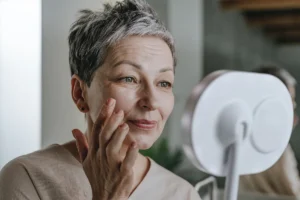
Checking the hairline regularly can help you notice changes sooner. Use good lighting and a mirror. A hand mirror or phone camera can help with hard-to-see areas.
Check:
- Forehead hairline
- Temples
- Sideburn area
- Around the ears
- Behind the ears
- Part line
- Crown of the scalp
- Back of the neck
- Areas with thinning hair
- Areas where hats, glasses, or helmets rub
When checking the hairline, ask:
- Is there a scab that keeps coming back?
- Is there a sore that has not healed?
- Is a spot bleeding, crusting, or oozing?
- Is there a rough patch in one specific area?
- Is a bump growing or becoming firm?
- Is there a mole or dark spot that has changed?
- Does one spot look different from the others?
- Has the spot lasted more than a few weeks?
For moles or dark spots, use the ABCDEs:
- Asymmetry: One half of the spot does not match the other.
- Border: The edges are uneven, jagged, blurred, or poorly defined.
- Color: The spot has more than one color, such as brown, black, red, white, blue, or pink.
- Diameter: The spot is larger than a pencil eraser or continues to grow.
- Evolving: The spot changes in size, shape, color, texture, or symptoms.
The “E” for evolving is especially important. A changing spot should be checked.
When Should You See a Dermatologist?
Schedule a skin cancer screening if a hairline spot does not heal, keeps coming back, grows, bleeds, crusts, hurts, itches, or looks different from other marks on your skin.
You should also get checked if you notice:
- A scab that does not go away
- A sore that bleeds or crusts repeatedly
- A rough or scaly patch in one area
- A shiny or pearly bump
- A firm red, pink, or flesh-colored bump
- A wart-like growth
- A changing mole or dark spot
- A spot that looks infected but does not improve
- A lesion near the forehead, temples, ears, or part line
- A spot that concerns you for any reason
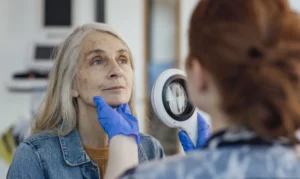
A dermatologist may examine the area, use dermoscopy, or recommend a biopsy if the spot looks suspicious. A biopsy is the only way to confirm whether a suspicious spot is skin cancer.
How Is Skin Cancer on the Hairline Treated?
Treatment for skin cancer on the hairline depends on the diagnosis, cancer type, size, depth, location, biopsy findings, recurrence history, medical history, and provider recommendation.
Common treatment options may include:
- Mohs surgery: A surgical technique that removes thin layers of skin and checks them for cancer cells until no cancer remains.
- Surgical removal: A procedure that removes the skin cancer along with a margin of surrounding tissue.
- Image-Guided SRT: A non-surgical treatment option for certain nonmelanoma skin cancers, including basal cell skin cancer and squamous cell skin cancer.
- Other treatments: Depending on the diagnosis, options may include topical medication, cryotherapy, photodynamic therapy, immunotherapy, radiation therapy, or another approach recommended by your provider.
Hairline location can matter because this area may involve the forehead, temples, scalp, ears, and visible facial skin. Cosmetic outcome, healing, hair coverage, and nearby structures may all affect treatment planning.
Is IGSRT an Option for Skin Cancer on the Hairline?
IGSRT, also known as Image-Guided SRT, may be an option for eligible patients with certain nonmelanoma skin cancers, including basal cell skin cancer and squamous cell skin cancer.
For some eligible patients, IGSRT may help treat certain nonmelanoma skin cancers without cutting, stitches, or downtime. It uses imaging and targeted radiation to treat the cancer while allowing the provider to monitor the area during treatment.
IGSRT is not appropriate for every skin cancer or every hairline location. Eligibility depends on the diagnosis, cancer type, size, depth, location, medical history, and provider recommendation.
How to Help Protect Your Hairline
The hairline can be missed during sun protection, especially near the temples, part line, ears, and thinning areas.
To help protect your hairline:
- Apply broad-spectrum sunscreen with SPF 30 or higher up to the hairline
- Apply sunscreen to exposed scalp areas, including the part line
- Reapply sunscreen when outdoors for long periods
- Reapply after sweating, swimming, or toweling off
- Wear a wide-brimmed hat when possible
- Consider UPF-rated hats or sun-protective clothing
- Avoid tanning beds, tanning booths, and sunlamps
- Check the hairline regularly for new or changing spots
- Ask your dermatologist to check your hairline and scalp during skin exams
Sun protection cannot prevent every skin cancer, but it can help reduce additional UV damage and support earlier detection.
FAQ: Skin Cancer on the Hairline
Can skin cancer appear on the hairline?
Yes. Skin cancer can appear along the forehead hairline, temples, sideburn area, part line, around the ears, or near the back of the neck. A persistent or changing spot should be checked by a dermatologist.
What does skin cancer on the hairline look like?
Skin cancer on the hairline may look like a scab that does not heal, rough patch, crusted sore, shiny bump, firm red or pink bump, wart-like growth, changing mole, or dark spot.
Can a scab on the hairline be skin cancer?
Yes, a scab on the hairline can sometimes be a sign of skin cancer, especially if it does not heal, keeps coming back, bleeds, crusts, grows, or changes.
Why does the hairline get skin cancer?
The hairline can receive frequent UV exposure and is often missed during sunscreen application. Hair, hats, grooming, and skin care routines can also make changes harder to notice.
Can skin cancer appear near the temples?
Yes. Skin cancer can appear near the temples, where sun exposure is common and spots may be mistaken for irritation from glasses, shaving, or hair products.
Can skin cancer appear around the ears and hairline?
Yes. Skin cancer can appear around the ears, behind the ears, and along the nearby hairline. This area is often missed during sunscreen application and self-checks.
Can skin cancer appear along the part line?
Yes. The part line can receive direct sun exposure, especially if the hair is parted the same way every day. A scab, sore, rough patch, or changing spot along the part line should be checked.
How can I tell if a hairline spot is acne or skin cancer?
You may not be able to tell by looking. Acne or irritation often improves, while skin cancer may persist, bleed, crust, grow, or return in the same place. A dermatologist can evaluate the spot.
When should I see a dermatologist for a hairline spot?
See a dermatologist if the spot does not heal within a few weeks, keeps coming back, grows, bleeds, crusts, hurts, itches, changes color, or looks different from other marks on your skin.
How is a suspicious hairline spot diagnosed?
A dermatologist may examine the spot, use dermoscopy, and recommend a biopsy if it looks suspicious. A biopsy can confirm whether the spot is skin cancer or another condition.
How is skin cancer on the hairline treated?
Treatment depends on the diagnosis, cancer type, size, depth, location, and provider recommendation. Options may include Mohs surgery, surgical removal, Image-Guided SRT, or other treatments recommended by your provider.
Is IGSRT an option for skin cancer on the hairline?
IGSRT may be an option for eligible patients with certain nonmelanoma skin cancers, including basal cell skin cancer and squamous cell skin cancer. A dermatologist can determine whether IGSRT is appropriate.
Learn More About Skin Cancer Treatment on the Hairline With GentleCure®
If you notice a hairline scab, sore, rough patch, bump, or changing spot that does not heal, schedule an exam with a dermatologist. Getting the right diagnosis is the first step toward the right treatment plan.
If you have been diagnosed with certain nonmelanoma skin cancers, including basal cell skin cancer or squamous cell skin cancer, GentleCure may be an option. GentleCure uses IGSRT, also known as Image-Guided SRT, a non-surgical treatment option for certain nonmelanoma skin cancers. For eligible patients, it may help treat basal cell skin cancer or squamous cell skin cancer without cutting, stitches, or downtime.
Treatment recommendations depend on the diagnosis, cancer type, size, depth, location, medical history, and provider recommendation. To learn more, call 855-936-4411 to speak with a Skin Cancer Information Specialist, find a participating dermatology practice near you, or take the Am I a Candidate? quiz to see whether IGSRT may be right for you.