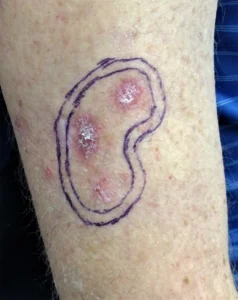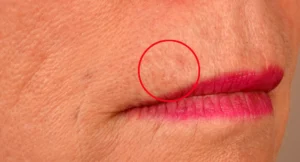
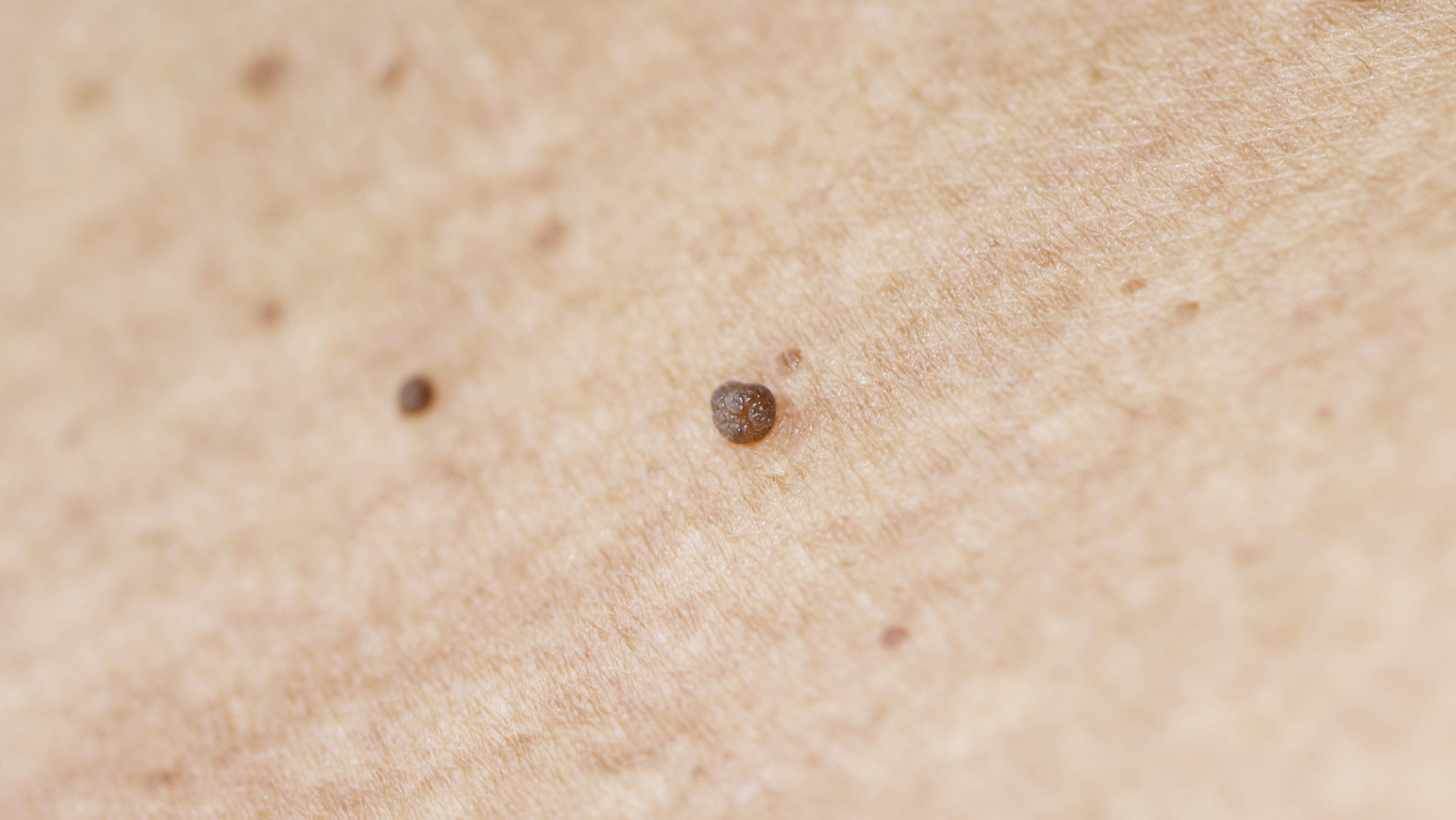
Can a skin tag look like skin cancer? Sometimes, a skin tag and skin cancer can both appear as small growths on the skin, but they usually behave differently. Skin tags are often soft, harmless, and attached by a small stalk, while a skin cancer on the face spot may grow, bleed, crust, change color, or fail to heal.
Skin tags are common and usually not cancerous. However, many people search for “skin tag or skin cancer” when they notice a new or changing growth and are unsure what it means. A dermatologist can evaluate the spot and determine whether it is a skin tag, mole, wart, benign growth, precancerous spot, skin cancer, or another condition.
This article is educational and is not a medical diagnosis. If a spot is changing, painful, bleeding, crusting, or looks different from other marks on your skin, schedule a dermatology exam.
What Is a Skin Tag?
A skin tag is a small, benign skin growth that often hangs from the skin by a narrow stalk. Skin tags are usually soft and may be the same color as your skin or slightly darker.
Skin tags commonly appear in areas where skin rubs against skin, clothing, or jewelry, such as:
- Neck
- Armpits
- Eyelids
- Under the breasts
- Chest
- Groin
- Skin folds
Skin tags are usually harmless and often do not require treatment unless they become irritated, catch on clothing, bleed from friction, or bother you cosmetically.
Skin Tag or Skin Cancer: What to Keep in Mind
Skin tags and early signs of skin cancer can sometimes be confused because both may appear as a new or raised spot on the skin. The difference often comes down to how the growth looks, feels, and changes over time.
A skin tag is usually:
- Soft
- Small
- Skin-colored or slightly darker
- Attached by a narrow stalk
- Smooth or slightly wrinkled
- Stable over time
- Painless unless irritated by friction
A suspicious skin cancer spot may:
- Grow or change over time
- Bleed, crust, or scab
- Become painful, tender, or itchy
- Develop uneven color
- Look shiny, pearly, rough, scaly, or ulcerated
- Become an open sore
- Have irregular borders
- Look different from other spots on your skin
Not every changing spot is skin cancer, and not every skin-colored bump is a skin tag. A dermatologist can help identify the difference.
Skin Tag vs. Skin Cancer: Key Differences
| Feature | Skin Tag | Possible Skin Cancer |
|---|---|---|
| Texture | Soft, smooth, or slightly wrinkled | Rough, scaly, crusted, shiny, pearly, firm, or ulcerated |
| Attachment | Often hangs from a narrow stalk | Usually attached more broadly or appears as a spot, patch, bump, or sore |
| Growth pattern | Usually stable or slow-growing | May grow, change, bleed, crust, or fail to heal |
| Color | Skin-colored, tan, or slightly darker | Pink, red, flesh-colored, brown, black, white, blue, or multiple colors |
| Pain or itching | Usually painless unless irritated | May be painless, tender, painful, itchy, or burning |
| Bleeding | May bleed if irritated or twisted | May bleed with minor contact or repeatedly scab |
| Borders | Usually smooth and uniform | May have irregular, poorly defined, or changing borders |
| Location | Common in skin folds or friction areas | Often on sun-exposed areas, but can appear anywhere |
This table is a general guide. A dermatologist can determine whether a spot is a skin tag or something else.
When a “Skin Tag” Should Be Checked
A growth that looks like a skin tag should be checked if it does not behave like a typical skin tag.
Make an appointment with a dermatologist if the spot:
- Grows quickly
- Changes color, shape, size, or texture
- Bleeds, crusts, or scabs
- Becomes painful, tender, itchy, or burning
- Looks dark, uneven, shiny, pearly, rough, or scaly
- Develops an open sore
- Has irregular or poorly defined borders
- Looks different from other spots on your skin
- Appears on sun-exposed skin and does not heal
- Returns after removal or treatment
- Is a new growth that concerns you
Get urgent care if there is spreading redness, fever, rapidly worsening pain or swelling, or drainage that suggests an infection.
Size and Appearance
Skin tags are often small, soft, and attached to the skin by a narrow stalk. They may look like a tiny flap of skin and often have a smooth or slightly wrinkled surface.
Skin cancer can vary much more in appearance. It may look like a rough patch, shiny bump, firm growth, open sore, changing mole, or crusted spot. Some skin cancers may be skin-colored, while others may appear pink, red, brown, black, white, or uneven in color.
A spot should be checked if it grows, changes, bleeds, crusts, or looks different from other marks on your skin.
Attachment to the Skin
A skin tag often hangs from the skin by a small stalk. This is one of the features that makes a skin tag look different from many other growths.
Skin cancer usually does not hang from a thin stalk in the same way. It may appear as a spot, patch, bump, sore, or growth attached more directly to the skin. However, some benign growths and irritated lesions can be difficult to identify without an exam.
Do not pull, cut, or remove a growth at home.
Changes Over Time
Skin tags often remain fairly stable over time. They may slowly enlarge, especially in areas with friction, but they typically do not change rapidly.
A skin cancer spot may continue to change. It may grow, bleed, crust, scab, become painful, develop uneven color, or fail to heal.
Changes to watch for include:
- Rapid growth
- Color changes
- New bleeding or crusting
- A sore that does not heal
- A smooth spot becoming rough or scaly
- A painless spot becoming tender or itchy
- A growth that looks different from nearby skin tags or moles
The “E” for evolving is one of the most important warning signs. If a spot is changing, it should be checked.
Color Changes
Skin tags are often close to your natural skin tone, though they may appear tan or slightly darker. They are usually fairly uniform in color.
A suspicious spot may have uneven color or multiple colors, including pink, red, brown, black, white, or blue. It may also darken, become inflamed, or develop a color pattern that looks different from nearby marks.
A dark or changing spot should be evaluated, especially if it is not clearly a typical skin tag.
Texture
Skin tags are usually soft and flexible. They may feel smooth or slightly wrinkled.
Skin cancer may feel rough, scaly, firm, crusted, thickened, tender, or like a sore that keeps reopening. Some skin cancers feel like a dry patch that does not improve.
Texture alone cannot diagnose a spot, but a growth that becomes rough, firm, crusted, or scaly should be checked.
Pain, Itching, or Bleeding
A skin tag is usually painless unless it becomes irritated by clothing, jewelry, shaving, or friction. Irritated skin tags may become red, sore, or occasionally bleed.
Skin cancer may be painless, especially early on. However, some spots may itch, hurt, bleed, crust, or feel tender. A growth that bleeds with minor contact or repeatedly scabs should be evaluated.
Bleeding should not automatically be dismissed as irritation, especially if it happens more than once.
Location
Skin tags commonly appear in areas where skin rubs together, including the neck, armpits, eyelids, under the breasts, chest, groin, and other skin folds.
Skin cancer can appear anywhere, but many common skin cancers develop on sun-exposed areas such as the face, ears, scalp, neck, chest, arms, hands, and legs.
A skin-colored growth in a skin fold may be a skin tag, but location alone is not enough to confirm what it is.
Can Skin Cancer Look Like a Skin Tag?
Yes, skin cancer can sometimes be mistaken for a skin tag, especially if it appears as a small raised growth. This is why it is important to look at the whole pattern, including growth, color, texture, bleeding, and whether the spot is changing.
A spot may be more concerning if it:
- Is new and growing
- Bleeds or crusts
- Becomes firm or painful
- Has uneven color
- Does not look like your other skin tags
- Appears on sun-exposed skin
- Does not heal
- Returns after removal
If you are not sure whether a growth is a skin tag, schedule a dermatology exam before trying to remove it.
Can a Skin Tag Become Skin Cancer?
Skin tags themselves are usually benign and do not typically become skin cancer. However, a growth that looks like a skin tag may not actually be a skin tag.
A dermatologist should evaluate any growth that is changing, bleeding, painful, crusting, darkening, or different from your other skin tags. This is especially important if the spot has not been diagnosed before.
Skin Tag vs. Mole vs. Skin Cancer
Skin tags, moles, and skin cancers can sometimes be confused.
A skin tag is usually a soft, hanging growth attached by a narrow stalk.
A mole is usually a flat or raised pigmented spot. Many moles are harmless, but a mole that changes should be checked.
A skin cancer spot may appear as a sore, scab, rough patch, shiny bump, firm growth, or changing mole. It may grow, bleed, crust, hurt, itch, or fail to heal.
For moles and dark spots, use the ABCDEs:
- Asymmetry: One half of the spot does not match the other.
- Border: The edges are uneven, jagged, blurred, or poorly defined.
- Color: The spot has more than one color, such as brown, black, red, white, blue, or pink.
- Diameter: The spot is larger than a pencil eraser or continues to grow.
- Evolving: The spot changes in size, shape, color, texture, or symptoms.
Any changing mole or dark spot should be evaluated.
Should a Skin Tag-Like Growth Be Evaluated Before Removal?
A dermatologist should evaluate any growth that is changing, bleeding, painful, irritated, unusual, or not clearly a typical skin tag before it is removed. This is especially important because some skin cancers and other skin conditions can resemble a skin tag.
A skin tag-like growth should be checked if it:
- Bleeds or crusts
- Changes color or size, is painful, or itchy
- Looks dark or uneven
- Appears on the eyelid, face, genitals, or another sensitive area
- Does not clearly look like your other skin tags
- Has not been evaluated before
A dermatologist can safely evaluate the spot and recommend the right next step.
How Is a Suspicious Skin Tag-Like Growth Diagnosed?
A dermatologist may examine the growth and ask how long it has been there, whether it has changed, and whether it has bled, crusted, hurt, or returned after treatment.
The exam may include:
- A visual skin exam
- Dermoscopy, which uses a special tool to look more closely at the spot
- Photos or measurements for monitoring
- A biopsy if the growth looks suspicious
A biopsy is the only way to confirm whether a suspicious growth is skin cancer. During a biopsy, a small sample of tissue is removed and reviewed by a lab.
Skin Cancer Prevention: Use the ABCDE Method
The ABCDE method can help you monitor moles and dark spots, but it is also useful as a reminder to watch for changing skin growths.
Look for:
- Asymmetry: One half does not match the other.
- Border: Edges are uneven, jagged, blurred, or poorly defined.
- Color: The spot has more than one color, such as brown, black, red, white, blue, or pink.
- Diameter: The spot is larger than a pencil eraser or continues to grow.
- Evolving: The spot changes in size, shape, color, texture, or symptoms.
The ABCDEs are not only for moles. Any spot that changes, bleeds, crusts, grows, hurts, itches, or does not heal should be checked.
How Is Skin Cancer Treated if It Looks Like a Skin Tag?
Treatment depends on the diagnosis, type of skin cancer, size, depth, location, biopsy findings, recurrence history, medical history, and provider recommendation.
Common treatment options may include:
- Mohs surgery: A surgical technique that removes thin layers of skin and checks them for cancer cells until no cancer remains.
- Surgical removal: A procedure that removes the skin cancer along with a margin of surrounding tissue.
- Image-Guided SRT: A non-surgical treatment option for certain nonmelanoma skin cancers, including basal cell skin cancer and squamous cell skin cancer.
- Other treatments: Depending on the diagnosis, options may include topical medication, cryotherapy, photodynamic therapy, immunotherapy, radiation therapy, or another approach recommended by your provider.
If the growth is a skin tag, treatment is different and may not be medically necessary unless it is irritated or bothersome.
Is IGSRT an Option for Skin Cancer That Looks Like a Skin Tag?
IGSRT, also known as Image-Guided SRT, may be an option for eligible patients with certain nonmelanoma skin cancers, including basal cell skin cancer and squamous cell skin cancer.
IGSRT is not a treatment for ordinary skin tags, benign growths, acne, cysts, infections, or melanoma.
Eligibility depends on the diagnosis, cancer type, size, depth, location, medical history, and provider recommendation. A dermatologist can help determine whether IGSRT or another treatment option is appropriate.
FAQ: Skin Tags vs. Skin Cancer
Can skin tags be a sign of cancer?
Skin tags are usually benign and are not typically a sign of cancer. However, a growth that looks like a skin tag but changes, bleeds, crusts, hurts, or looks unusual should be checked.
Can skin cancer look like a skin tag?
Yes, skin cancer can sometimes be mistaken for a skin tag, especially if it appears as a small raised growth. A dermatologist can evaluate the spot and determine what it is.
How can I tell if it is a skin tag or skin cancer?
A skin tag is often soft, small, and attached by a narrow stalk. Skin cancer may grow, bleed, crust, change color, become firm, or fail to heal. You may not be able to tell by looking, so suspicious spots should be evaluated.
Can a skin tag turn into skin cancer?
Skin tags themselves are usually benign and do not typically become skin cancer. However, a spot that looks like a skin tag may not actually be one, especially if it changes or bleeds.
Is it normal for a skin tag to bleed?
A skin tag can bleed if it is irritated, twisted, cut, or rubbed. However, a growth that bleeds repeatedly or bleeds with minor contact should be checked by a dermatologist.
When should I see a dermatologist for a skin tag?
See a dermatologist if the growth changes, bleeds, crusts, hurts, itches, grows quickly, becomes dark or uneven, looks different from your other skin tags, or appears in a sensitive area.
What does basal cell skin cancer look like?
Basal cell skin cancer may look like a shiny bump, pink patch, open sore, scab that returns, scar-like area, or bump with tiny visible blood vessels.
What does squamous cell skin cancer look like?
Squamous cell skin cancer may look like a rough or scaly patch, firm bump, crusted sore, wart-like growth, thickened area, or sore that does not heal.
Can melanoma look like a skin tag?
Melanoma is less likely to look like a typical skin tag, but it can appear as a changing, raised, dark, uneven, or unusual spot. Any changing dark spot should be checked promptly.
How is a suspicious skin tag-like growth diagnosed?
A dermatologist may examine the spot, use dermoscopy, and recommend a biopsy if it looks suspicious. A biopsy can confirm whether the growth is skin cancer or another condition.
Is IGSRT an option for skin cancer that looks like a skin tag?
IGSRT may be an option for eligible patients with certain nonmelanoma skin cancers, including basal cell skin cancer and squamous cell skin cancer. It is not a treatment for ordinary skin tags.
Learn More About Skin Cancer Treatment With GentleCure
If you notice a skin tag-like growth that changes, bleeds, crusts, hurts, grows, or looks unusual, schedule an exam with a dermatologist. Getting the right diagnosis is the first step toward the right treatment plan.
If you have been diagnosed with certain nonmelanoma skin cancers, including basal cell skin cancer or squamous cell skin cancer, GentleCure may be an option. GentleCure uses IGSRT, also known as Image-Guided SRT, as a non-surgical treatment option for certain nonmelanoma skin cancers. For eligible patients, IGSRT may help treat basal cell skin cancer or squamous cell skin cancer without cutting or stitches.
Treatment recommendations depend on the diagnosis, cancer type, size, depth, location, medical history, and provider recommendation. To learn more, call 855-936-4411 to speak with a Skin Cancer Information Specialist, find a participating dermatology practice near you, or take the Am I a Candidate? quiz to see whether IGSRT may be right for you.