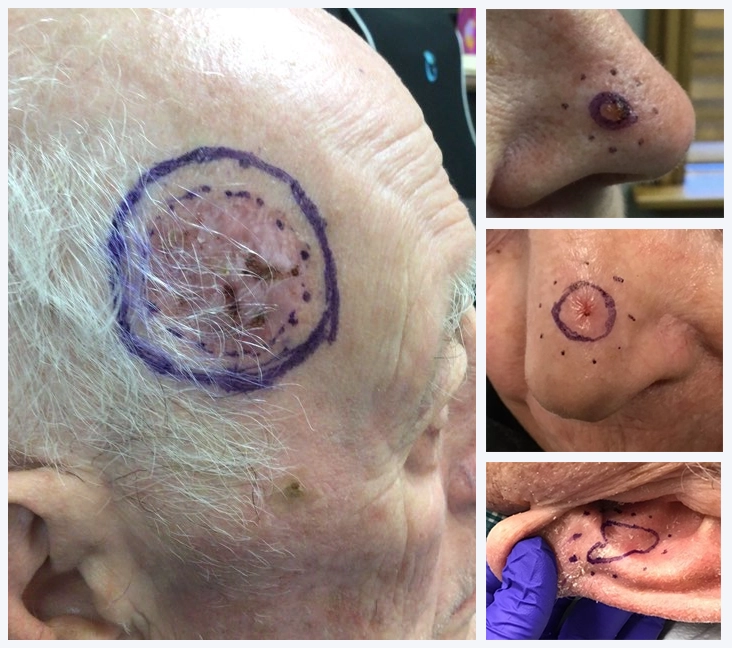
What are the symptoms of basal cell skin cancer? Common signs include a shiny or pearly bump, a sore that does not heal, a pink or red patch, a scar-like area, or a growth that bleeds, crusts, or repeatedly heals and returns. On darker skin tones, basal cell skin cancer may also appear brown, black, gray, or blue.
Basal cell skin cancer, also called basal cell carcinoma (BCC), is the most common type of skin cancer. It often develops slowly and may cause few noticeable symptoms at first.
Although basal cell skin cancer rarely spreads to distant parts of the body, it can grow deeper into surrounding tissue if left untreated. Recognizing changes early and having suspicious areas evaluated by a dermatologist can help prevent complications.
What Does Basal Cell Skin Cancer Look Like?
Basal cell skin cancer can appear in several ways, and its appearance may differ based on the type of growth, body location, and skin tone.
Here are some of the most common visual signs.
A Shiny or Pearly Bump
One common sign is a small, raised bump with a shiny, translucent, or pearly appearance.
The bump may be pink, red, or skin-colored. On darker skin tones, it can appear brown, black, or another darker shade.
Some bumps contain small, visible blood vessels near the surface.
This appearance is commonly associated with nodular basal cell skin cancer.
An Open Sore That Does Not Heal
A sore that remains open for several weeks or repeatedly heals and returns may be a sign of basal cell skin cancer.
The area may:
- Bleed after minor irritation
- Develop a crust or scab
- Appear to heal temporarily
- Reopen in the same location
- Become tender or irritated
Persistent or recurring sores should be evaluated by a dermatologist.
A Pink or Reddish Growth
Basal cell skin cancer may appear as a pink or reddish growth with slightly raised, rolled edges.
Some growths have a depressed center or small blood vessels visible across the surface.
The affected area may gradually enlarge over time.
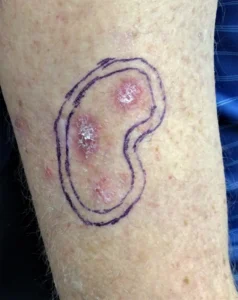
A Flat, Scaly, or Irritated Patch
Some basal cell skin cancers appear as flat patches that resemble eczema, dermatitis, or other common skin conditions.
These patches may be:
- Pink or red
- Dry or scaly
- Slightly raised around the edges
- Itchy or irritated
- Persistent despite ordinary skin care
Because these symptoms can resemble noncancerous conditions, a professional evaluation is important when a patch does not improve.
A White, Yellow, or Scar-Like Area
Some basal cell skin cancers develop as smooth, waxy, or scar-like areas.
They may appear white, pale yellow, or similar to the surrounding skin.
The area may have indistinct borders or feel firmer than nearby skin.
This appearance can be associated with certain infiltrative forms of basal cell skin cancer that may extend beyond what is visible on the surface.
Early Signs of Basal Cell Skin Cancer
Early basal cell skin cancer may be subtle.
A small bump, rough patch, or unusual spot may not seem concerning at first, especially when it causes no pain or other symptoms.
Watch for:
- A new bump that slowly grows
- A spot with a shiny or unusual surface
- A sore that does not heal
- A scab that repeatedly returns
- A flat patch that persists
- A new scar-like mark without a known injury
- A spot that changes in appearance over time
Not every unusual skin change is cancer. However, persistent or changing spots deserve medical attention.
What Does Basal Cell Skin Cancer Look Like on Different Skin Tones?
Basal cell skin cancer can affect people of every skin tone, although its appearance may vary.
Basal Cell Skin Cancer on Lighter Skin
On lighter skin tones, basal cell skin cancer may look like:
- A shiny pink or red bump
- A pearly or translucent growth
- A reddish, scaly patch
- A pale scar-like area
- A sore that crusts or bleeds
Basal Cell Skin Cancer on Darker Skin
On darker skin tones, basal cell skin cancer may appear:
- Brown or black
- Gray or bluish
- Similar to the surrounding skin color
- As a dark, shiny bump
- As a pigmented growth that resembles a mole
Some basal cell skin cancers contain pigment, making them more difficult to distinguish from other skin growths by appearance alone.
Skin tone should never be used to rule out skin cancer.
A dermatologist can examine a suspicious growth and determine whether further testing is needed.
Where Does Basal Cell Skin Cancer Usually Appear?
Basal cell skin cancer commonly develops on areas frequently exposed to ultraviolet (UV) radiation.
These include:
- Face and nose
- Forehead and temples
- Eyelids
- Ears
- Scalp and hairline
- Neck
- Shoulders
- Chest and back
- Arms and hands
Although sun-exposed areas are common locations, basal cell skin cancer can also develop in areas that receive less direct sunlight.
Basal Cell Skin Cancer on the Face
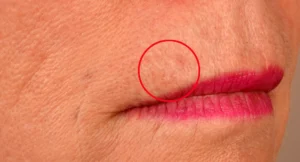
The face is a common location for basal cell skin cancer.
A suspicious spot may appear as a shiny bump, persistent sore, crusted patch, or slowly growing area near the nose, eyes, forehead, or cheeks.
Because facial skin cancers can occur near sensitive structures, early evaluation and appropriate treatment planning are especially important.
Basal Cell Skin Cancer on the Nose
Basal cell skin cancer on the nose may appear as a small pearly bump, a sore that repeatedly bleeds, or a patch that does not heal.
Its appearance can sometimes resemble a pimple or other harmless growth.
A spot that persists or changes should be examined by a dermatologist.
Does Basal Cell Skin Cancer Itch, Hurt, or Bleed?
Basal cell skin cancer does not always cause pain, itching, or other noticeable sensations.
For some people, the only sign is a visible change in the skin.
However, symptoms may include:
- Itching
- Tenderness
- Bleeding
- Crusting
- Irritation
- Pain
- Unusual sensitivity
A growth may bleed after rubbing against clothing, being scratched, or experiencing minor irritation.
The absence of pain does not mean a spot is harmless.
Can Basal Cell Skin Cancer Look Like a Pimple, Mole, or Eczema?
Yes. Basal cell skin cancer can resemble several common skin conditions.
Pimple vs. Basal Cell Skin Cancer
A pimple typically improves or resolves over time.
Basal cell skin cancer may resemble a pimple but persist, slowly enlarge, bleed, or repeatedly crust and return.
A bump that does not heal should be evaluated.
Mole vs. Basal Cell Skin Cancer
Some pigmented basal cell skin cancers resemble moles because they contain brown, black, or blue pigmentation.
A new, changing, or unusual pigmented growth should be assessed by a dermatologist.
Eczema vs. Basal Cell Skin Cancer
Certain basal cell skin cancers appear as red, dry, or scaly patches.
These may resemble eczema or another inflammatory skin condition.
If a patch persists, changes, or does not respond as expected to treatment, professional evaluation is appropriate.
How Is Basal Cell Skin Cancer Diagnosed?
A dermatologist can evaluate a suspicious spot and determine whether it may be skin cancer.
During the appointment, the provider may examine the area and ask about changes in appearance, symptoms, medical history, and previous skin cancers.
The evaluation may include:
Visual Skin Examination
The dermatologist examines the suspicious growth and surrounding skin, looking at its size, color, texture, shape, and other characteristics.
Dermoscopy
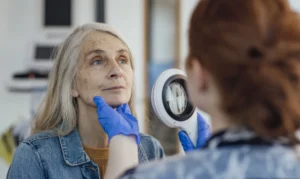
A dermatologist may use a handheld magnifying device called a dermatoscope to examine structures in the skin that are difficult to see with the naked eye.
Skin Biopsy
If skin cancer is suspected, the dermatologist may perform a biopsy.
A small sample of tissue is removed and examined under a microscope to confirm the diagnosis and help identify the type of skin cancer.
Appearance alone cannot reliably confirm or exclude basal cell skin cancer.
What Are the Treatment Options for Basal Cell Skin Cancer?
Basal cell skin cancer is highly treatable when diagnosed and managed appropriately.
Treatment depends on the cancer’s size, depth, location, subtype, risk characteristics, and the patient’s medical history.
Common treatment approaches include:
Mohs Surgery
Mohs surgery removes cancerous tissue in stages, examining each layer under a microscope until no cancer cells remain at the examined margins.
It is frequently recommended for skin cancers in sensitive locations or those with higher-risk features.
Surgical Excision
Surgical excision removes the skin cancer along with a margin of surrounding tissue.
The removed tissue may be examined to assess whether cancer cells are present at the margins.
Topical Medications
Certain prescription topical medications may be appropriate for selected superficial basal cell skin cancers.
They are not suitable for every cancer type, location, or depth.
Image-Guided SRT (IGSRT)
Image-Guided SRT is a surgery-free treatment option for certain basal cell skin cancers.
It combines ultrasound imaging with targeted radiation to treat the affected area without cutting or stitches.
IGSRT is not appropriate for every basal cell skin cancer, and treatment recommendations should be based on a dermatologist’s assessment.
Other Treatment Approaches
Depending on the diagnosis, other approaches may include curettage and electrodesiccation, cryotherapy, other forms of radiation therapy, or medications for advanced disease.
A dermatologist can explain which treatment options are appropriate for a particular diagnosis.
When Should You See a Dermatologist for Basal Cell Skin Cancer Symptoms?
Schedule a dermatology appointment if you notice a spot that:
- Does not heal
- Repeatedly bleeds or crusts
- Changes in size, color, or appearance
- Gradually grows
- Looks different from surrounding skin
- Resembles a persistent pimple or sore
- Develops without an obvious cause
People with a personal history of skin cancer may need regular follow-up examinations, depending on their dermatologist’s recommendation.
Early evaluation helps identify the cause of a suspicious growth and determine whether treatment is necessary.
FAQ: Basal Cell Skin Cancer Symptoms
What is usually the first sign of basal cell skin cancer?
An early sign may be a small shiny bump, a persistent sore, a pink or scaly patch, or a new scar-like area. Some basal cell skin cancers grow slowly and cause few symptoms.
What does early-stage basal cell skin cancer look like?
Early basal cell skin cancer may appear as a small pearly bump, a flat irritated patch, or a sore that does not fully heal. Its color and appearance can vary across skin tones.
Does basal cell skin cancer itch?
It can. Some people experience itching or irritation, while others have no noticeable symptoms beyond the appearance of the growth.
Is basal cell skin cancer painful?
Not always. Many basal cell skin cancers are painless, especially early on. Some may become tender, painful, irritated, or sensitive over time.
Can basal cell skin cancer look like a pimple?
Yes. It may resemble a pimple, particularly when it appears as a small pink or raised bump. Unlike a typical pimple, a basal cell skin cancer may persist, grow, bleed, or repeatedly heal and return.
Does basal cell skin cancer bleed?
It can. A basal cell skin cancer may bleed after minor irritation or develop a recurring crust or scab.
Can basal cell skin cancer be brown or black?
Yes. Some basal cell skin cancers are pigmented and may appear brown, black, gray, or blue, particularly on darker skin tones.
Where is basal cell skin cancer most common?
Basal cell skin cancer frequently develops on sun-exposed areas such as the face, nose, ears, scalp, neck, and shoulders. However, it can occur elsewhere on the body.
Can basal cell skin cancer spread?
Basal cell skin cancer rarely spreads to distant parts of the body. However, it can grow into surrounding tissue and cause local damage if left untreated.
How do dermatologists confirm basal cell skin cancer?
Dermatologists examine suspicious areas and may perform a skin biopsy. The tissue is evaluated under a microscope to confirm the diagnosis.
Can basal cell skin cancer be treated without surgery?
Yes. Certain basal cell skin cancers may be treated with surgery-free approaches, including Image-Guided SRT, depending on the diagnosis and patient eligibility.
Is IGSRT appropriate for every basal cell skin cancer?
No. IGSRT is a treatment option for selected cases. Eligibility depends on cancer characteristics, location, medical history, and provider recommendation.
Learn More About Basal Cell Skin Cancer Treatment Options With GentleCure
If you notice a suspicious bump, sore, scab, or changing area of skin, schedule an examination with a dermatologist.
If you have already been diagnosed with basal cell skin cancer, you may have several treatment options to discuss with your healthcare provider.
GentleCure Image-Guided SRT is a surgery-free treatment option for eligible patients with certain nonmelanoma skin cancers.
To learn more, call 855-936-4411 to speak with a Skin Cancer Information Specialist, explore whether IGSRT may be appropriate for your diagnosis, or find a participating dermatology practice near you.